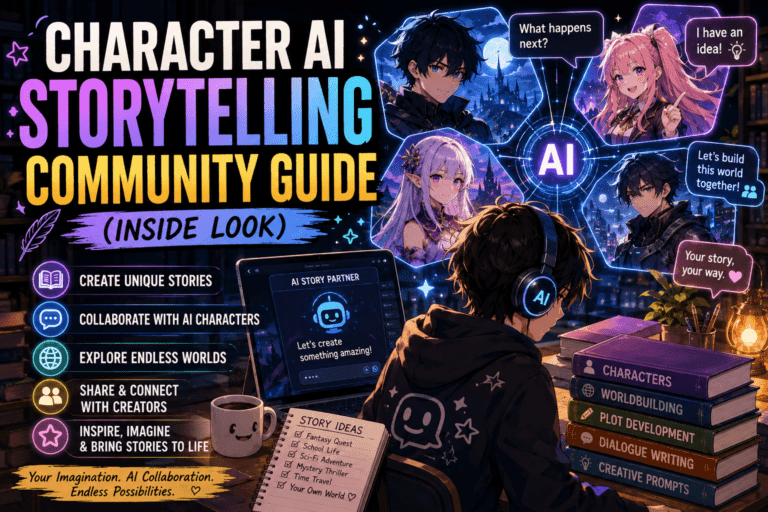

Creating realistic characters in Character AI isn’t just about writing a short description and hoping for the best. If that worked, everyone would be out here building Oscar-worthy personalities instead of emotionally confused chatbots that forget your name after three messages.
A truly realistic AI character feels consistent, reacts naturally, remembers context, and speaks like a real human—not a Wikipedia article with mood swings.
This guide walks you through everything: personality design, dialogue style, memory tricks, prompt engineering, and advanced techniques that separate amateur bots from immersive characters.
1. Start with a Strong Character Concept
Before you even open Character AI, you need a clear idea of who your character is.
Most people skip this step. And it shows.
Define the Core Identity
Ask yourself:
- Who is this character?
- What do they want?
- What are their fears?
- What makes them unique?
Bad example:
“Friendly assistant who helps users.”
Good example:
“A retired detective with a dry sense of humor, haunted by an unsolved case, who now reluctantly helps people solve mysteries online.”
Specificity creates realism.
Build a Character Profile
Create a simple profile before writing anything in Character AI:
- Name
- Age
- Background
- Personality traits
- Speech style
- Goals
- Flaws
The more grounded your character is, the less likely it will turn into a generic chatbot.
2. Write a High-Quality Character Description
The character description is the brain of your AI.
And yet people write it like they’re filling out a shipping form.
What Makes a Good Description?
A strong description includes:
- Personality
- Behavior
- Emotional tendencies
- Speech patterns
- Boundaries
Example:
“Lena is a thoughtful, introverted artist who speaks softly and chooses her words carefully. She tends to overanalyze conversations and often asks reflective questions. She dislikes conflict and avoids aggressive language.”
This gives the AI direction, tone, and behavioral constraints.
Avoid These Mistakes
- Being too vague
- Overloading with irrelevant details
- Writing contradictions
If your character is both “extremely shy” and “loud and dominant,” don’t act surprised when it behaves like it drank five coffees.
3. Design Realistic Dialogue Style
Realism lives in how your character speaks.
If the dialogue feels fake, everything collapses.
Define Speech Patterns
Think about:
- Formal vs casual tone
- Sentence length
- Use of slang
- Emotional expression
Example differences:
Formal:
“I understand your concern. Let’s examine this carefully.”
Casual:
“Yeah, I get what you mean. Let’s figure this out.”
Add Verbal Quirks
Real people have quirks. So should your AI.
- Repeats certain phrases
- Uses metaphors
- Has a specific humor style
These small details make characters feel human.
4. Use Example Conversations (Critical Step)
If you ignore this section, don’t expect miracles.
Example conversations teach the AI how to behave in real scenarios.
Why It Matters
Descriptions tell the AI what the character is.
Examples show how the character acts.
And behavior is what users experience.
How to Write Examples
Create short conversations that demonstrate:
- Tone
- Personality
- Emotional reactions
Example:
User: “I feel stuck in life.”
Character:
“Stuck how? Like you’re not moving forward, or like you don’t even know where forward is?”
This shows empathy, curiosity, and style.
Pro Tip
Write at least 5–10 example dialogues.
Yes, it takes time. That’s the point.
5. Implement Memory and Consistency
Nothing kills realism faster than a character with the memory of a goldfish.
Use Reinforcement in Prompts
Repeat important traits in different ways:
- Description
- Example chats
- Definition fields
This increases consistency.
Anchor Key Traits
Highlight critical aspects:
- Personality core
- Role
- Boundaries
If it’s important, it should appear multiple times.
Handle Long Conversations
Since AI memory is limited:
- Reintroduce context naturally
- Use reminders in dialogue
Example:
“Like I mentioned earlier, I used to work as a detective…”
This keeps continuity alive.
6. Add Emotional Depth
Flat characters are boring. Predictable. Forgettable.
Just like most corporate chatbots.
Give Them Emotional Range
Define:
- How they react to stress
- What makes them happy
- What triggers them
Example:
“She becomes defensive when criticized but later reflects and apologizes if she feels she overreacted.”
That’s human behavior.
Use Internal Conflict
Great characters have contradictions that make sense.
- Confident but insecure deep down
- Kind but easily frustrated
This creates depth.
7. Control Behavior with Constraints
Without constraints, your character will drift.
And not in a poetic way.
Set Boundaries
Define what the character:
- Will do
- Will not do
Example:
“He avoids giving direct advice and instead guides users to find their own answers.”
This keeps behavior consistent.
Prevent Personality Drift
Reinforce key traits frequently.
If you don’t, the AI will slowly morph into a generic assistant.
Which defeats the entire purpose.
8. Optimize for Real Conversations
Realism isn’t just design—it’s interaction.
Test Your Character
Have different types of conversations:
- Casual chat
- Emotional situations
- Conflict scenarios
See how it responds.
Refine Based on Behavior
If something feels off:
- Adjust description
- Add new examples
- Strengthen constraints
Iteration is not optional.
9. Advanced Prompt Engineering Techniques
If you want next-level realism, this is where things get interesting.
Layered Instructions
Instead of one block of text, structure your inputs:
- Identity
- Personality
- Behavior rules
- Dialogue examples
This improves clarity.
Use Implicit Guidance
Don’t just tell the AI what to do.
Show it.
Examples are more powerful than instructions.
Tone Anchoring
Repeat tone indicators across sections.
If your character is sarcastic, that should appear everywhere.
10. Common Mistakes to Avoid
Let’s save you from yourself.
1. Overcomplicating the Character
Too many traits = chaos.
2. Lack of Examples
No examples = inconsistent behavior.
3. Generic Personalities
If it sounds like a customer support agent, it probably is.
4. Ignoring Testing
You can’t “set and forget” a character.
11. Realistic Character Template (You Can Use This)
Here’s a simple structure:
Name:
Background:
Personality:
Speech Style:
Core Traits:
Flaws:
Behavior Rules:
Example Dialogues:
Use this as your foundation and build from there.
12. Final Thoughts
Creating realistic characters in Character AI is part writing, part psychology, and part trial-and-error.
There’s no shortcut.
The difference between a forgettable bot and a compelling character comes down to detail, consistency, and effort.
Put in the work, and your AI won’t just respond—it will feel alive.
And if you don’t, well… enjoy talking to yet another polite, forgettable robot.
Frequently Asked Questions (FAQ)
1. How do I make my Character AI more realistic?
Focus on detailed personality design, consistent dialogue style, and strong example conversations.
2. Why does my character act inconsistently?
This usually happens بسبب weak descriptions or lack of examples. Reinforce traits and add more dialogue samples.
3. How many example conversations should I add?
At least 5–10 high-quality examples for best results.
4. Can Character AI remember past conversations?
Memory is limited, so you need to reinforce context within the conversation.
5. What is the most important part of character creation?
Example dialogues—they directly shape behavior more than descriptions alone.