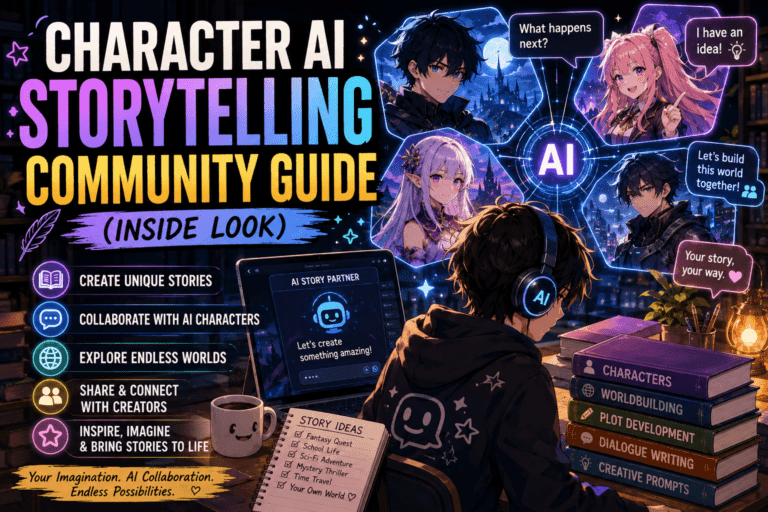


At some point, you realize Character AI isn’t the problem. Your prompts are.
Beginners blame the AI when conversations feel flat. Power users understand something slightly uncomfortable: the quality of the interaction depends heavily on how you drive it.
Character AI: What It Is, How It Works, and Why Millions Use It (Complete Guide)
This guide is for people who are past “Hi” and ready to actually control the experience.
The Power User Mindset
If you want better outputs, stop treating Character AI like a chatbot and start treating it like a collaborative system.
That means:
- You guide tone and direction
- You introduce structure
- You maintain consistency
The AI follows patterns. You create them.
Prompt Framing Techniques
Context Anchoring
Always establish:
- Who you are
- Who the AI is
- Where the scene takes place
- What’s currently happening
Weak prompt:
“Let’s roleplay.”
Strong prompt:
“We’re detectives in a city where crime is controlled by a hidden organization. You don’t trust me, and I suspect you’re hiding something.”
Role Locking
Explicitly define behavior:
- Personality traits
- Speaking style
- Emotional tone
Example:
“You are calm, analytical, and slightly distant. You avoid emotional responses and focus on logic.”
This reduces randomness.
Constraint Injection
Limit behavior intentionally:
- “You cannot reveal your secret directly.”
- “You must respond in short, tense sentences.”
Constraints force more interesting outputs.
Controlling Conversation Flow
Push-Pull Technique
- Introduce information
- Withhold key details
This creates tension and engagement.
Layered Responses
Instead of short replies, build layers:
- Action
- Dialogue
- Internal thoughts
Example:
“She hesitates, glancing at the door. ‘You shouldn’t be here,’ she says quietly, clearly hiding something.”
Steering Without Breaking Immersion
Avoid:
- Direct instructions mid-roleplay
Use subtle nudges instead:
- “You seem hesitant, like you’re deciding whether to trust me.”
Memory Management Strategies
Character AI doesn’t perfectly remember everything.
So you:
- Reintroduce important details naturally
- Reinforce key facts over time
Example:
“As we discussed earlier, you’re still hiding the truth about the mission.”
Advanced Roleplay Techniques
Multi-Character Control
You can control multiple roles in one conversation.
Example:
- You narrate side characters
- AI focuses on main character
Scene Transitions
Smoothly move between scenes:
- “Hours later…”
- “The next morning…”
Keeps narrative flowing.
Dynamic Conflict Creation
If things get boring, introduce conflict:
- New threat
- Unexpected twist
- Emotional tension
Writing Style Optimization
Match the AI’s Tone
If you write:
- Detailed → AI responds detailed
- Minimal → AI responds minimal
You set the standard.
Use Descriptive Language
More detail = better immersion
Avoid Breaking Character
Stay consistent with your role.
Debugging Bad Responses
When the AI goes off-track:
Soft Reset
- Reframe context
- Reinforce roles
Hard Reset
- Restart conversation
- Use stronger initial prompt
Engagement Optimization
Introduce Stakes Early
Without stakes, conversations feel flat.
Use Uncertainty
Keep some information hidden.
Build Emotional Hooks
Make interactions personal.
Common Power User Mistakes
- Over-controlling the AI
- Being inconsistent
- Ignoring narrative flow
Balance control with flexibility.
Creating High-Quality Characters
Define:
- Backstory
- Motivations
- Flaws
Flawed characters feel real.
Experimentation Strategies
Try:
- Different genres
- Unique constraints
- Alternate personalities
You learn by testing.
Conclusion
Character AI becomes significantly more powerful once you understand how to guide it.
The difference between average and exceptional conversations isn’t the AI. It’s how you use it.
Once you master these techniques, you stop reacting to the AI and start directing it.
FAQs
What makes someone a power user in Character AI?
Someone who understands how to control prompts, structure conversations, and guide interactions.
How do I improve my prompts?
Add context, constraints, and clear roles.
Why does the AI forget things?
Because memory is limited, so you need to reinforce key details.
How do I make conversations more engaging?
Introduce conflict, emotion, and uncertainty.
Can I fully control the AI?
Not completely, but you can guide it significantly.