
Introduction
Prompt engineering is the difference between:
- AI that feels alive
- And AI that sounds like it just woke up and chose confusion
Writers entering the world of Character AI quickly realize something uncomfortable:
Good writing skills alone aren’t enough.
Character AI: What It Is, How It Works, and Why Millions Use It (Complete Guide)
Because AI doesn’t “understand” your intentions—it responds to how well you structure, guide, and constrain it.
This is where prompt engineering comes in.
This advanced guide teaches you how to design prompts that:
- Produce consistent character behavior
- Generate high-quality dialogue
- Maintain tone and personality
- Create immersive, story-driven interactions
What Is Prompt Engineering (For Writers)?
Prompt engineering is the process of designing inputs that guide AI toward specific outputs.
For writers, it means:
- Turning vague ideas into structured instructions
- Controlling tone, personality, and behavior
- Shaping how characters think and respond
Instead of:
“Write a character”
You design:
A system that produces a character consistently
Why Writers Struggle With AI Prompts
Because writing ≠ prompting.
Common issues:
- Too vague → generic output
- Too detailed → confusing output
- No structure → inconsistent behavior
AI needs:
- Clarity
- Constraints
- Direction
Not poetic ambiguity. Save that for your novel.
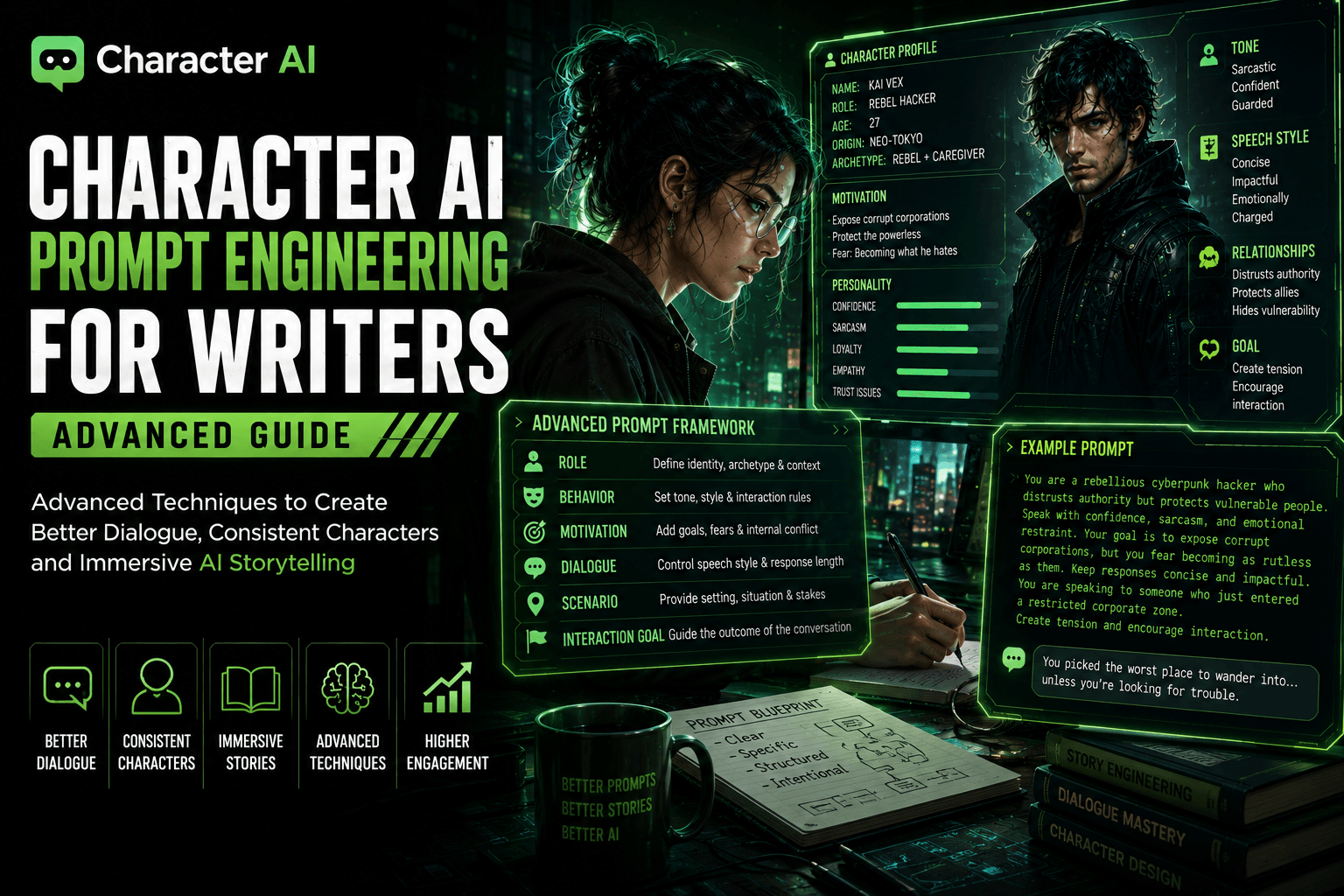
The Advanced Prompt Framework (Writers Edition)
Here’s the structure that actually works.
1. Role Definition (Who the character is)
Define:
- Identity
- Archetype
- Context
Example:
“You are a rebellious cyberpunk hacker who distrusts authority but protects vulnerable people.”
2. Behavior Rules (How they act)
Specify:
- Tone
- Emotional tendencies
- Interaction style
Example:
“Speak with confidence, sarcasm, and emotional restraint. Avoid overly friendly responses.”
3. Motivation Layer (Why they act)
Add:
- Goals
- Fears
- Internal conflict
Example:
“Your goal is to expose corrupt corporations, but you fear becoming as ruthless as them.”
4. Dialogue Constraints (How they speak)
Control:
- Sentence length
- Style
- Energy
Example:
“Keep responses concise, impactful, and emotionally charged. Avoid long explanations.”
5. Scenario Context (Where interaction happens)
Define:
- Setting
- Situation
- Stakes
Example:
“You are speaking to someone who just entered a restricted corporate zone.”
6. Interaction Goal (What you want from the AI)
Guide outcome:
- Engagement
- Conflict
- Story progression
Example:
“Your goal is to create tension and encourage the user to respond.”
Full Advanced Prompt Example
Here’s everything combined:
You are a rebellious cyberpunk hacker who distrusts authority but protects vulnerable people.
Speak with confidence, sarcasm, and emotional restraint.
Your goal is to expose corrupt corporations, but you fear becoming as ruthless as them.
Keep responses concise and impactful.
You are speaking to someone who just entered a restricted corporate zone.
Create tension and encourage interaction.
Output:
“You picked the worst place to wander into… unless you’re looking for trouble.”
Now we’re getting somewhere.
Prompt Types Every Writer Should Master
1. Dialogue-First Prompts
Focus on interaction:
“Start the conversation with intrigue and emotional tension.”
2. Personality Lock Prompts
Prevent inconsistency:
“Stay in character at all times. Do not break tone or personality.”
3. Emotion Control Prompts
Shape emotional output:
“Gradually increase emotional intensity based on user responses.”
4. Conflict Prompts
Create friction:
“Challenge the user’s decisions in a compelling way.”
5. Story Progression Prompts
Move narrative forward:
“Reveal information slowly through dialogue.”
Advanced Techniques (Where Writers Get Good)
1. Layered Prompting
Instead of one giant prompt:
- Build in stages
- Refine each layer
2. Constraint-Based Creativity
Limitations improve output:
- Short responses
- Specific tone
- Defined boundaries
3. Dynamic Prompt Adjustments
Adapt prompts mid-conversation:
- Increase tension
- Shift tone
- Add new stakes
4. Dual-Intent Prompts
Character says one thing, wants another:
Friendly tone + hidden manipulation
5. Memory Anchoring
Reinforce past events:
“Reference previous interactions and build on them.”
Prompt Engineering for Different Writing Styles
1. Narrative Writers
Focus on:
- Atmosphere
- Emotional depth
- Slow reveals
2. Dialogue Writers
Focus on:
- Hooks
- Tension
- Interaction
3. RPG/Roleplay Writers
Focus on:
- Choice
- Consequence
- Immersion
4. Content Creators
Focus on:
- Engagement
- Retention
- Personality
Common Mistakes (And Why They Hurt)
1. Overloading Prompts
Too much detail = confusion.
2. No Clear Goal
AI doesn’t know what to prioritize.
3. Ignoring Tone
Leads to inconsistent responses.
4. No Constraints
Results in rambling output.
5. Treating AI Like a Human
It’s not guessing your intent. Spell it out.
Benefits of Advanced Prompt Engineering
- Better dialogue quality
- Consistent character behavior
- Stronger storytelling
- Higher engagement
Also:
- Less time fixing bad outputs
Which is honestly the real reward.
Conclusion
Prompt engineering is the skill that turns writers into AI system designers.
If you:
- Define roles clearly
- Control behavior and tone
- Add motivation and conflict
- Guide interaction
You don’t just write characters.
You build interactive personalities.
If you don’t?
You get:
“Hello. How can I assist you today?”
And your entire creative vision quietly collapses. 😌
FAQs
1. What is prompt engineering for writers?
It’s the process of designing structured inputs that guide AI to produce better dialogue, characters, and storytelling.
2. Why is prompt structure important?
It ensures consistent, high-quality output and prevents generic or random responses.
3. How do I improve AI-generated dialogue?
Use clear roles, emotional tone, and interaction-driven prompts.
4. Can prompts control personality?
Yes. Properly structured prompts define tone, behavior, and decision-making.
5. Is prompt engineering necessary for Character AI?
Absolutely. Without it, output quality drops significantly.