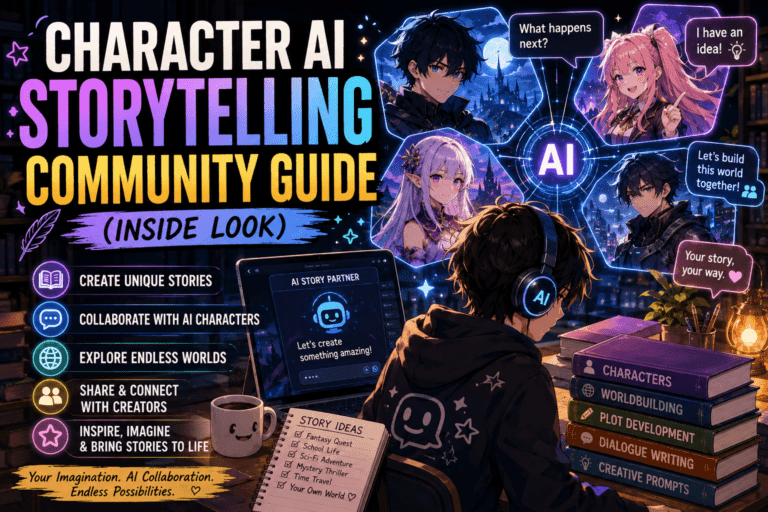

Game characters used to be predictable.
They followed scripts, repeated lines, and reacted the same way every time. Players learned their patterns, and the illusion broke pretty quickly.
Now, with AI-driven systems, you can create characters that feel dynamic, responsive, and alive (without actually being alive, let’s stay grounded).
This guide walks you through how to create AI characters for games step by step, from concept to implementation.
1. Start with a Strong Character Concept
Before touching any AI tools, you need a clear idea of who your character is.
If your concept is weak, the AI will amplify that weakness beautifully.
Define:
- Name
- Role (merchant, companion, villain, etc.)
- Personality traits
- Background story
- Goals and motivations
Example:
Instead of:
“Helpful NPC”
Create:
“A cynical blacksmith who distrusts outsiders but secretly wants recognition”
Specificity creates depth. Depth creates better interactions.
2. Design Personality and Behavior Rules
AI characters need structure.
Without it, they drift into generic responses.
Define Behavior:
- Tone (formal, sarcastic, friendly)
- Speaking style (short, detailed, emotional)
- Attitude toward the player
- Boundaries (what they will or won’t discuss)
Why This Matters:
- Maintains consistency
- Prevents out-of-character responses
- Improves immersion
Think of it as giving your character a spine instead of letting it collapse into randomness.
3. Build a Character Prompt (Core Instruction)
This is the foundation of your AI character.
It tells the AI how to behave.
Include:
- Character identity
- Personality traits
- Backstory
- Interaction style
- Rules of behavior
Example Prompt Structure:
- “You are a medieval guard…”
- “You speak in a strict, authoritative tone…”
- “You distrust strangers but respect bravery…”
A well-written prompt does most of the heavy lifting.
A bad prompt creates a confused character that contradicts itself every five messages.
4. Create Dialogue Style and Examples
AI learns from patterns.
Give it examples of how the character should speak.
Provide:
- Sample dialogues
- Typical responses
- Emotional reactions
Example:
Player: “Can I enter the city?”
Character: “State your business. I don’t open gates for wanderers without reason.”
This helps:
- Maintain tone
- Improve realism
- Reduce generic replies
5. Add Context Awareness
Games are dynamic. Your characters should be too.
Include Context Variables:
- Player actions
- Game events
- Location
- Relationship status
Example:
- If player helped the character → friendlier tone
- If player betrayed them → hostile responses
This creates:
- Reactive behavior
- Personalized experiences
Without context, your AI character feels disconnected from the game world.
6. Use Memory (Even If Limited)
AI memory isn’t perfect, but you can simulate it.
Methods:
- Store key events
- Track player choices
- Reinforce important details
Example:
- “The player saved your village. You remember this and trust them.”
Even basic memory:
- Improves immersion
- Builds continuity
- Strengthens relationships
Otherwise, your character forgets everything like it just woke up from a nap every five minutes.
7. Combine AI with Scripted Systems
Pure AI sounds exciting. It’s also risky.
Best Approach: Hybrid System
Use:
- AI for dynamic dialogue
- Scripts for critical moments
Why:
- Ensures narrative control
- Prevents unexpected behavior
- Keeps story coherent
Think of AI as improv and scripts as your safety net.
8. Test, Break, Fix, Repeat
Your character will fail at first.
That’s not a bug. That’s the process.
Testing Focus:
- Consistency
- Relevance
- Tone accuracy
- Edge cases
Common Issues:
- Repetition
- Out-of-character responses
- Confusion in long conversations
Fix by:
- Refining prompts
- Adding examples
- Adjusting rules
Iteration is where good characters are actually made.
9. Optimize for Player Experience
Don’t build characters just because the tech is cool.
Build them because they improve gameplay.
Focus On:
- Engagement
- Clarity
- Emotional impact
- Fun
If your AI character is technically impressive but boring to interact with, congratulations, you built a very advanced disappointment.
10. Scale and Expand
Once your system works, expand carefully.
Add:
- More characters
- Deeper relationships
- Complex interactions
But keep:
- Consistency
- Quality control
- Clear design
Scaling bad design just gives you more bad design.
Tools and Technologies to Use
To build AI characters, developers typically use:
- Large Language Models (LLMs)
- Dialogue systems
- Game engines (Unity, Unreal Engine)
- API integrations
You don’t need everything at once. Start simple, then build up.
Final Thoughts
Creating AI characters for games isn’t just about technology.
It’s about:
- Design
- Psychology
- Storytelling
AI gives you flexibility.
But without structure, it turns into chaos.
The goal is to create characters that:
- Feel consistent
- React meaningfully
- Enhance the player experience
Not just characters that talk a lot.
Because players don’t remember how advanced your AI was.
They remember how it made them feel.
And if your character feels real enough to matter, you’ve done something right.
FAQs – How to Create AI Characters for Games
What is the first step in creating AI characters for games?
The first step is defining a clear character concept, including personality, role, background, and motivations to ensure consistent and engaging behavior.
How do you make AI characters feel realistic in games?
You make AI characters feel realistic by giving them consistent personality traits, context awareness, memory of past interactions, and natural dialogue patterns.
Do AI game characters need scripted dialogue?
Yes, combining AI-generated dialogue with scripted elements ensures better control, consistency, and narrative structure in games.
What tools are used to create AI characters for games?
Developers use large language models (LLMs), game engines like Unity or Unreal Engine, and APIs to integrate AI-driven dialogue systems into games.
What are common mistakes when creating AI characters?
Common mistakes include weak character design, lack of clear behavior rules, over-reliance on AI without structure, and insufficient testing.