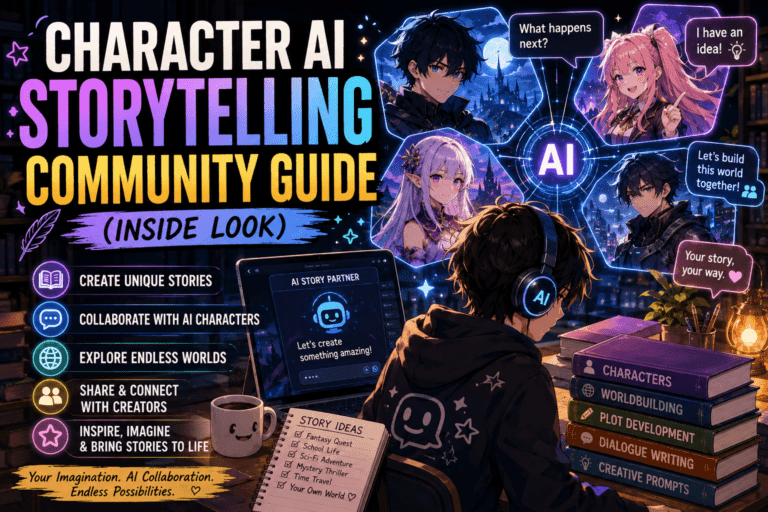

How small teams are building scalable, dynamic narratives without massive writing overhead
Indie game developers are increasingly exploring AI-powered storytelling—not as a novelty, but as a practical solution to a familiar constraint: limited time, budget, and writing resources.
Character AI: What It Is, How It Works, and Why Millions Use It (Complete Guide)
A Character AI story engine is emerging as a viable approach. Instead of scripting every branch, developers design systems where characters generate dialogue, react to player input, and evolve over time. Tools like Character.AI and Inworld AI have made this model more accessible, even for solo developers.
But building a working story engine requires more than plugging in an AI model. It involves structure, constraints, and careful narrative design.
This guide breaks down how indie developers can realistically build and ship a Character AI story engine that works.
Table of Contents
What Is a Character AI Story Engine?
A Character AI story engine is a system that generates narrative interactions dynamically, centered around AI-driven characters rather than pre-written dialogue trees.
Instead of this:
- Fixed dialogue options
- Predefined story branches
- Static NPC behavior
You get:
- Real-time dialogue generation
- Context-aware character responses
- Emergent story progression
These systems are typically built using models similar to OpenAI GPT models combined with orchestration layers like LangChain.
Why Indie Developers Are Adopting It
For small teams, the appeal is straightforward:
1. Reduced Content Burden
Instead of writing thousands of dialogue lines, developers define character rules and let the system generate variations.
2. Increased Replayability
AI-driven interactions create different experiences across playthroughs without additional content production.
3. Scalable Narrative Systems
A single well-designed character system can produce hours of gameplay.
However, these benefits only materialize if the system is designed carefully.
Core Components of a Character AI Story Engine
Building a functional engine involves more than just API calls. It requires a layered system.
System Architecture Overview
| Component | Purpose |
|---|---|
| Language Model | Generates dialogue and responses |
| Character Profiles | Define personality, goals, constraints |
| Memory System | Stores past interactions |
| Narrative Controller | Guides story direction and constraints |
| Input Parser | Interprets player intent |
1. Character Profiles: The Foundation
Every AI story engine starts with strong character design.
Instead of scripts, create structured character profiles:
- Goals and motivations
- Personality traits
- Speaking style
- Knowledge boundaries
Example Character Spec
| Attribute | Example |
|---|---|
| Role | Tavern keeper |
| Personality | Friendly but secretive |
| Goal | Protect hidden smuggling route |
| Speech Style | Casual, slightly evasive |
This ensures consistent behavior even with dynamic generation.
2. Memory Systems: Context That Matters
Memory enables continuity—but must be controlled.
Most indie setups use:
- Pinecone
- Weaviate
Types of Memory to Implement
| Memory Type | Function |
|---|---|
| Short-term | Current conversation context |
| Long-term | Major player decisions |
| World memory | Shared lore and facts |
Practical Tip
Store summaries, not full transcripts. This reduces cost and improves relevance.
3. Narrative Controller: Keeping the Story Coherent
Without structure, AI narratives drift.
A narrative controller acts as a lightweight director:
- Enforces key plot points
- Maintains pacing
- Prevents contradictions
Example Constraints
- The player must discover the artifact before Act 2
- The antagonist identity cannot change mid-game
- Certain locations unlock in sequence
This hybrid approach balances freedom and structure.
4. Dialogue Generation: Controlled Flexibility
Raw AI output can feel inconsistent or overly verbose.
To improve quality:
- Use structured prompts
- Limit response length
- Reinforce character voice
Prompt Structure Example
You are a cautious tavern keeper.
You avoid revealing secrets unless trust is high.
Respond in 2–3 sentences.
This keeps dialogue tight and believable.
5. Player Input Design: Guiding Interaction
Fully open-ended input can overwhelm systems.
Instead, use guided input models:
- Suggested intents (“Ask about rumors”)
- Hybrid systems (free text + choices)
- Contextual prompts
This improves both usability and narrative control.
6. Performance and Cost Considerations
Indie developers must optimize for efficiency.
Key Strategies
- Cache common responses
- Limit memory retrieval scope
- Use smaller models when possible
Not every interaction needs a large model call.
7. Testing and Iteration
AI story engines require continuous tuning.
What to Test
| Area | Focus |
|---|---|
| Consistency | Does the character stay in role? |
| Continuity | Do past actions matter? |
| Edge cases | How does AI handle odd inputs? |
| Performance | Response time and cost |
Testing should feel closer to debugging a system than reviewing a script.
Tools Commonly Used by Indie Developers
Here’s a practical stack many developers experiment with:
| Layer | Tools |
|---|---|
| Engine | Unity or Unreal Engine |
| AI Model | OpenAI GPT models |
| Orchestration | LangChain |
| Memory | Pinecone / Weaviate |
This stack is flexible and can be scaled up or down depending on project scope.
Common Pitfalls to Avoid
Even well-designed systems can fail if these issues aren’t addressed:
- Over-reliance on AI — leads to incoherent narratives
- No constraints — causes story drift
- Too much memory — creates contradictions
- Unstructured input — overwhelms the system
A working engine is always a balance between control and flexibility.
Where Character AI Story Engines Are Headed
For indie developers, the next phase is likely to include:
- Persistent character worlds across sessions
- Player-specific narrative memory
- Hybrid authored + AI-generated story arcs
Platforms like Inworld AI are already exploring these directions, especially for real-time game environments.
Key Takeaways
- Character AI story engines replace scripted dialogue with dynamic systems
- Strong character profiles are essential for consistency
- Memory should be structured and selective
- Narrative controllers prevent story drift
- Guided player input improves interaction quality
- Performance optimization is critical for indie teams
- Testing requires system-level thinking
FAQ
What is a Character AI story engine?
A system that uses AI to generate dynamic dialogue and story interactions centered around character behavior rather than fixed scripts.
Is this approach viable for solo developers?
Yes, especially with lightweight tools and careful system design. Many indie developers start small and expand gradually.
What tools are needed to build one?
Common tools include Unity, LangChain, and vector databases like Pinecone.
Does AI replace game writers?
No. Writers shift toward designing characters, systems, and narrative constraints rather than scripting every line.
How do you prevent AI from going off-track?
By using narrative controllers, structured prompts, and defined constraints.
Is it expensive to run?
Costs vary depending on model usage, but optimization strategies can make it manageable for indie teams.