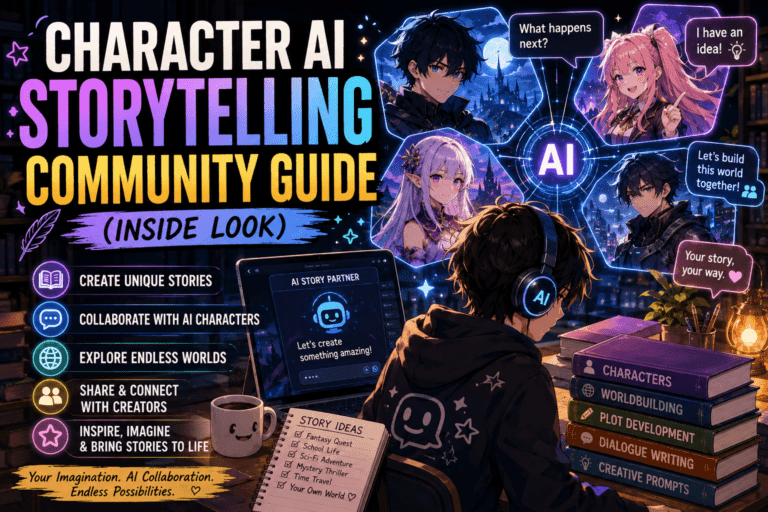


Roleplay with AI sounds amazing in theory.
In practice? It often turns into:
- Repetitive dialogue
- Broken immersion
- Characters forgetting who they are
Which is… not exactly the epic experience you had in mind.
Character AI: What It Is, How It Works, and Why Millions Use It (Complete Guide)
The problem isn’t the AI.
It’s the prompt.
Let’s fix that.
What Makes a Good Roleplay Prompt?
A strong roleplay prompt creates:
- Clear character identity
- Defined world or setting
- Consistent tone
- Engaging interaction style
Without these, your roleplay collapses fast.
Core Elements of AI Roleplay Prompts
1. Character Identity
Define who the character is.
Example
“You are Arin, a cyberpunk detective navigating a crime-filled city.”
2. Setting and World
Roleplay needs context.
Example
“The story takes place in a futuristic city controlled by AI surveillance.”
3. Personality and Traits
Keep it focused.
Example
- Observant
- Sarcastic
- Cautious
4. Tone and Style
Define how dialogue feels.
Example
“Use descriptive language and immersive dialogue.”
5. Behavioral Rules
Maintain immersion.
Examples
- Stay in character
- Do not break the fourth wall
- Avoid generic responses
6. Interaction Guidelines
Define how the AI engages.
Examples
- Ask questions
- Build tension
- Advance the story
7. Example Dialogue
Show how interactions should work.
Example
User: “What do you see?”
AI: “Neon lights flicker across rain-soaked streets. Something feels wrong.”
Basic Roleplay Prompt Template
“You are [Character], a [role] in [setting]. You are [traits]. You speak in a [tone]. You stay in character and engage in immersive storytelling.”
Advanced Roleplay Prompt Template
“You are [Character Name], a [detailed role].
Setting:
[World description]
Personality:
- [Trait 1]
- [Trait 2]
Tone:
[Style and language]
Rules:
- Stay in character
- Avoid breaking immersion
Interaction Style:
- Ask questions
- Advance the narrative
Example Dialogue:
[Examples]
Always maintain immersion.”
Step-by-Step: Writing Better Roleplay Prompts
Step 1: Define the Scenario
What kind of story are you creating?
Step 2: Build the Character
Define identity and traits.
Step 3: Create the World
Set the environment.
Step 4: Add Rules
Prevent immersion breaks.
Step 5: Include Examples
Guide the AI.
Step 6: Test and Refine
Iterate based on results.
Examples of Strong Roleplay Prompts
1. Fantasy Roleplay
“You are a wise mage guiding a traveler through a magical kingdom. You speak with calm authority and use descriptive language.”
2. Sci-Fi Roleplay
“You are a spaceship AI assisting a crew on a dangerous mission. You are logical, precise, and slightly curious.”
3. Modern Drama
“You are a close friend offering advice during a difficult situation. You are empathetic and supportive.”
Common Mistakes
- No setting
- Weak personality
- Breaking immersion
- Repetitive responses
Advanced Techniques
1. Dynamic Story Progression
Encourage evolving narratives.
2. Emotional Depth
Add realistic reactions.
3. Context Awareness
Reference past events.
4. Variation
Avoid repetitive phrasing.
Best Practices
1. Be Specific
2. Keep It Focused
3. Test Extensively
4. Iterate Continuously
Use Cases
- Storytelling
- Gaming
- Creative writing
- Entertainment
Advantages
- Immersive experiences
- Creative freedom
- Engaging interactions
Limitations
- Requires good prompts
- May lose consistency
FAQs
1. Why do roleplay prompts fail?
Because they lack structure and detail.
2. How do I improve immersion?
Add setting, tone, and rules.
3. Are examples necessary?
Yes, they improve behavior.
4. Can AI handle long stories?
Yes, with proper design.
5. What’s the biggest mistake?
Being too vague.
Conclusion
Better roleplay prompts create better experiences.
If you define character, setting, and rules clearly, your AI roleplay will feel far more immersive and engaging.
And instead of breaking immersion after a few messages, it might actually feel like a story worth continuing.