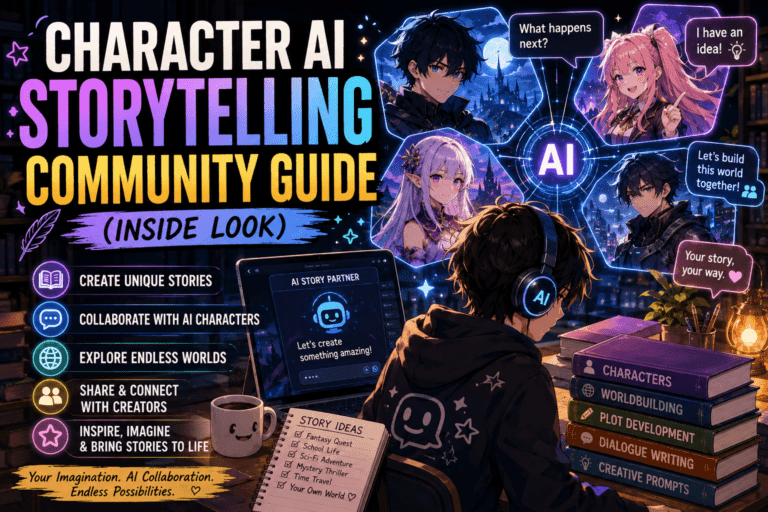

How to build believable, replayable AI-driven stories in modern games
AI-driven characters are changing how games are written, played, and experienced. Platforms like Character.AI and advances in large language models have made it possible to design narratives that adapt in real time to player behavior. But dynamic storytelling introduces a new challenge: how do you maintain coherence, emotional depth, and player agency when your “writer” is partially algorithmic?
Character AI: What It Is, How It Works, and Why Millions Use It (Complete Guide)
This guide breaks down practical narrative design techniques that actually work when building games powered by character AI systems—whether you’re developing indie interactive fiction or experimenting with emergent storytelling systems.
Narrative Design Tips I Wish I’d Known
Table of Contents
Why AI Narrative Design Is Different
Traditional game writing is deterministic. Even in branching narratives, outcomes are pre-authored. AI narrative design shifts that model toward probabilistic storytelling—where dialogue, tone, and even plot direction can evolve dynamically.
That creates three core tensions:
- Control vs. emergence — Too much freedom leads to incoherent stories
- Consistency vs. flexibility — Characters must feel stable but adaptable
- Narrative arc vs. player agency — Stories still need structure
Understanding these tensions is the foundation of effective AI-driven storytelling.
1. Design Characters as Systems, Not Scripts
In AI-based games, characters are not just dialogue trees—they’re behavioral systems.
Instead of writing fixed lines, define:
- Core motivations (what the character wants)
- Personality traits (tone, emotional tendencies)
- Boundaries (what they will never say or do)
This approach is similar to how developers structure prompts and memory in systems built with tools like OpenAI GPT models or LangChain.
Practical Tip
Write a “character spec” like this:
| Attribute | Example |
|---|---|
| Goal | Protect the kingdom at all costs |
| Fear | Betrayal by allies |
| Speech Style | Formal, restrained |
| Moral Limits | Never harms civilians |
This ensures consistency even when dialogue is generated dynamically.
2. Anchor the Narrative With Soft Constraints
AI systems can drift. Without constraints, characters may contradict themselves or derail the story.
Instead of rigid scripting, use soft constraints:
- Narrative checkpoints (key events that must happen)
- World rules (magic systems, lore boundaries)
- Relationship states (trust levels, alliances)
These act as invisible rails while preserving player freedom.
Example
In a mystery game:
- The killer is always one of three characters
- Clues must gradually reveal the truth
- AI can improvise how clues are discovered, but not the outcome
This hybrid approach is increasingly common in experimental projects using Unity with AI integrations.
3. Use Memory Strategically (Not Excessively)
Memory is one of the most powerful—and risky—features in AI narratives.
Tools like Pinecone or Weaviate allow systems to store past interactions. But too much memory leads to:
- Slower performance
- Narrative inconsistency
- Overly complex character behavior
Best Practice
Use layered memory:
- Short-term memory — Recent dialogue context
- Long-term memory — Key player decisions
- Selective recall — Only surface relevant memories
Think of memory as narrative continuity—not a full transcript.
4. Design for Player-Led Dialogue, Not AI Monologues
A common mistake is letting AI dominate conversations.
Effective AI narratives are player-driven, meaning:
- The player initiates direction
- The AI reacts meaningfully
- Dialogue feels collaborative
What Works
- Prompt players with choices or intents
- Use AI to expand, not replace, player input
- Avoid overly long AI-generated responses
This mirrors successful conversational design patterns seen in apps like Replika, where engagement comes from interaction, not passive consumption.
5. Build Emotional Consistency Over Time
Players connect with characters that feel emotionally stable—even if they evolve.
To achieve this:
- Track emotional states (anger, trust, fear)
- Gradually adjust tone based on interactions
- Avoid abrupt personality shifts
Implementation Idea
| Player Action | Emotional Impact |
|---|---|
| Helps character | +Trust |
| Lies to character | -Trust |
| Saves their life | +Loyalty |
Over time, this creates a believable relationship arc.
6. Introduce Controlled Randomness
Randomness adds replayability—but too much breaks immersion.
Use bounded randomness:
- Vary dialogue phrasing
- Introduce minor behavioral differences
- Keep major plot beats stable
This approach is often used in procedural storytelling systems inspired by games like AI Dungeon.
7. Test Narratives Like Systems, Not Stories
Traditional playtesting focuses on narrative flow. AI narratives require system testing.
Test for:
- Character consistency across sessions
- Logical continuity in long interactions
- Edge cases (unexpected player inputs)
Testing Framework
| Test Type | What to Check |
|---|---|
| Stress Testing | Long conversations |
| Edge Testing | Unusual player inputs |
| Regression | Character personality drift |
This is closer to software QA than traditional narrative review.
8. Accept Imperfection—and Design Around It
AI narratives will never be perfectly controlled. Instead of fighting that:
- Embrace emergent storytelling
- Design systems that recover from errors
- Allow characters to acknowledge uncertainty
This makes the experience feel more natural—and less brittle.
Where AI Narrative Design Is Heading
AI-driven storytelling is still evolving, but several patterns are emerging:
- Hybrid systems combining authored plots with AI dialogue
- Persistent character worlds with long-term memory
- Player-specific narratives shaped by behavior over time
Studios experimenting with tools like Inworld AI are already exploring these directions, especially in open-world and live-service environments.
Key Takeaways
- AI characters should be designed as systems with motivations, not scripts
- Soft constraints help maintain narrative coherence without limiting freedom
- Memory should be selective and structured, not exhaustive
- Player agency should drive conversations, not AI verbosity
- Emotional consistency is critical for immersion
- Controlled randomness improves replayability
- Testing AI narratives requires system-level thinking
- Imperfection is part of the design space, not a flaw
FAQ
What is AI narrative design in games?
AI narrative design involves using AI systems to generate or influence story elements dynamically, including dialogue, character behavior, and plot progression.
How is Character AI used in games?
Platforms like Character.AI are used to simulate interactive characters that respond in real time, enabling more dynamic storytelling experiences.
Do AI-driven stories replace traditional writing?
No. Most effective systems combine authored narrative structure with AI-generated dialogue and interactions.
What tools are commonly used for AI storytelling?
Common tools include Unity, LangChain, and vector databases like Pinecone.
Is AI narrative design suitable for indie developers?
Yes. Many indie developers use lightweight AI integrations to create interactive fiction, NPC dialogue systems, and experimental gameplay.
What are the biggest challenges?
Maintaining consistency, preventing narrative drift, and balancing player agency with coherent storytelling.