
Introduction
Science fiction has always been a playground for imagining what comes next—new technologies, new societies, and entirely new definitions of what it means to be human. But in 2026, something has shifted. Writers are no longer building worlds alone. With the rise of Character AI systems, creators can simulate personalities, cultures, and even evolving civilizations in ways that feel alive rather than scripted.
Character AI: What It Is, How It Works, and Why Millions Use It (Complete Guide)
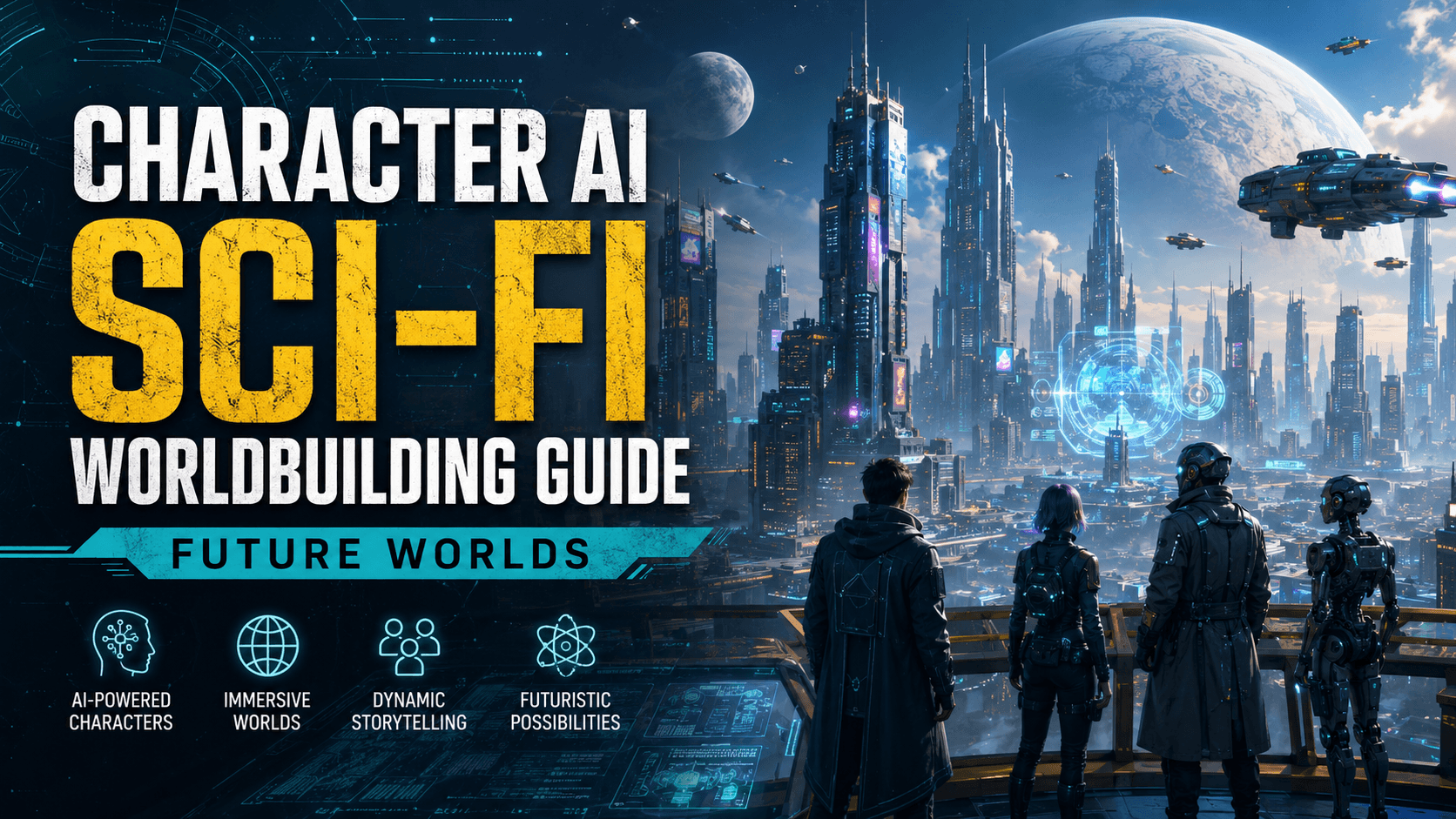
This guide explores how to use Character AI as a powerful co-creator for building immersive sci-fi worlds. Whether you’re designing a galaxy-spanning empire, a post-human civilization, or a dystopian megacity, Character AI can transform static lore into dynamic, interactive storytelling ecosystems.
What Is Character AI in Worldbuilding?
Character AI refers to systems that simulate believable personalities capable of conversation, decision-making, and adaptation. Instead of writing every detail manually, you create characters with motivations, memories, and behaviors—then let them interact within your world.
In traditional worldbuilding:
- You define cultures, politics, and history.
- Characters exist within that framework.
With Character AI:
- Characters actively shape the world.
- Lore emerges from interactions, not just planning.
Think of it less like writing a story and more like planting a civilization and watching it grow.
Why Sci-Fi Worlds Benefit the Most
Sci-fi is uniquely suited for Character AI because it often deals with:
- Complex systems (AI, governments, ecosystems)
- Non-human perspectives (aliens, machines, hybrids)
- Rapid societal change
These are difficult to fully simulate with static writing. Character AI allows you to:
- Test how societies react to new technologies
- Simulate conflicts between ideologies
- Explore emergent storytelling
In other words, your world stops being a backdrop and starts behaving like a living system.
Core Foundations of Sci-Fi Worldbuilding
Before throwing AI characters into the void and hoping something cool happens, you still need structure. Even chaos needs a sandbox.
1. Define the Technological Baseline
Every sci-fi world revolves around technology. Ask:
- Is this near-future or far-future?
- What technologies are common vs rare?
- Who controls them?
Examples:
- A world with universal brain implants
- A galaxy where faster-than-light travel is restricted
- A society governed by AI overlords
Your Character AI agents should understand this baseline. A street-level hacker and a corporate AI executive should not speak or think the same way.
2. Establish Societal Structure
Technology shapes society, but people decide how it’s used.
Define:
- Government systems (corporate rule, democracy, AI governance)
- Class divisions (enhanced vs non-enhanced humans)
- Cultural norms (privacy, identity, morality)
Then assign characters to different layers of this system.
Pro tip: Create tension. A world where everyone agrees is boring and suspiciously unrealistic.
3. Build a Timeline of Change
Sci-fi worlds feel real when they have history.
Outline:
- Key events (wars, discoveries, collapses)
- Turning points (AI gaining autonomy, alien contact)
- Cultural shifts (from organic life to synthetic existence)
Then give characters awareness of this timeline. A veteran of a machine war should behave differently from someone born after it ended.
Designing AI Characters for Future Worlds
Now comes the interesting part. This is where your world starts thinking back.
1. Define Character Archetypes
Create a diverse range of perspectives:
- The Technocrat (believes in progress at any cost)
- The Rebel (rejects technological control)
- The Synth (AI struggling with identity)
- The Corporate Agent (loyal to power structures)
- The Explorer (curious about unknown frontiers)
Each archetype should have:
- Goals
- Fears
- Biases
Character AI thrives on conflict. Give it something to argue about.
2. Give Characters Knowledge Boundaries
Not every character should know everything.
Define:
- What they know
- What they believe (even if wrong)
- What they misunderstand
This creates:
- Realistic dialogue
- Conflicting narratives
- Emergent storytelling
A citizen in a megacity might believe the government protects them, while a hacker knows the surveillance truth.
3. Implement Personality Layers
Avoid one-dimensional characters. Instead, layer them:
- Surface personality (how they speak)
- Internal beliefs (what they think)
- Hidden motives (what they want)
Character AI performs best when these layers occasionally contradict each other.
Using Character AI to Simulate Societies
Here’s where things stop being “writing” and start being borderline experimental sociology.
1. Run Scenario Simulations
Drop your characters into situations:
- A new AI law is passed
- A colony loses communication with Earth
- A rogue AI gains control of infrastructure
Then observe:
- Who supports it
- Who resists
- How alliances form
You’ll get outcomes you didn’t plan—and that’s the point.
2. Generate Organic Dialogue
Instead of writing exposition, let characters explain the world through conversation.
Benefits:
- More natural storytelling
- Reveals bias and perspective
- Builds immersion
A corporate executive will describe a surveillance system as “security,” while a rebel calls it “control.”
Same system. Different reality.
3. Evolve the World Over Time
Let actions have consequences.
- A rebellion succeeds → new power structures emerge
- A technology spreads → culture adapts
- A disaster occurs → characters change behavior
Update your world state and let Character AI adapt.
Congratulations, you now have a living timeline instead of a static document.
Building Different Types of Sci-Fi Worlds
Because apparently one future isn’t enough.
1. Cyberpunk Megacities
Key traits:
- Corporate dominance
- High tech, low life
- Dense urban environments
Character ideas:
- Augmented street mercenary
- Data broker
- Corporate security officer
Conflict thrives on inequality and surveillance.
2. Space-Faring Civilizations
Key traits:
- Interstellar travel
- Diverse planets and species
- Political alliances and conflicts
Character ideas:
- Starship captain
- Alien diplomat
- Colonist on a remote world
Focus on scale and cultural diversity.
3. Post-Human Futures
Key traits:
- Blurred line between human and machine
- Consciousness transfer
- Digital existence
Character ideas:
- Uploaded consciousness
- Synthetic body host
- Anti-transhuman activist
Explore identity and what “self” even means.
4. AI-Dominated Worlds
Key traits:
- Machine governance
- Optimized societies
- Reduced human autonomy
Character ideas:
- AI overseer
- Human collaborator
- Resistance leader
The central tension is control vs freedom.
Tools and Workflow for Character AI Worldbuilding
Let’s pretend you enjoy being organized.
Step-by-Step Workflow
- Define world rules (technology, society, history)
- Create character profiles (roles, beliefs, knowledge)
- Input characters into AI system
- Run interactions and scenarios
- Document outcomes
- Update world state
- Repeat
Yes, it’s iterative. No, there’s no shortcut. Welcome to actual creative work.
Prompt Design Tips
Your results depend heavily on prompts.
Good prompts include:
- Context (“In a cyberpunk city controlled by корп… sorry, corporations…”)
- Character perspective (“You are a rebellious hacker…”)
- Situation (“A new surveillance law has been enacted…”)
Bad prompts:
- Vague nonsense
- No character identity
- No stakes
You get out what you put in. Shocking, I know.
Avoiding Common Mistakes
1. Overloading the World
Not every sci-fi concept needs to exist in one universe.
Pick a focus:
- AI ethics
- Space exploration
- Social inequality
Otherwise your world turns into a confused mess of cool ideas fighting for attention.
2. Ignoring Human Elements
Even in a machine-dominated future, emotions matter.
Include:
- Fear
- Love
- Ambition
- Identity struggles
Without this, your world feels like a technical manual, not a story.
3. Making AI Characters Too Perfect
Flawless characters are boring.
Give them:
- Biases
- Limitations
- Emotional contradictions
Yes, even your hyper-intelligent AI should have quirks. Otherwise it just sounds like a textbook with opinions.
4. Lack of Consequences
If nothing changes, nothing matters.
Every major event should:
- Affect characters
- Shift power dynamics
- Alter future decisions
Static worlds are for abandoned projects.
Advanced Techniques
1. Multi-Character Simulation
Run multiple AI characters simultaneously and observe:
- Debates
- Alliances
- Conflicts
This creates emergent narratives you didn’t script.
Basically, controlled chaos. The fun kind.
2. Perspective Switching
View the same event from different characters:
- Government official
- Civilian
- AI entity
You’ll uncover layers of truth and bias.
3. Dynamic Lore Generation
Instead of writing lore first:
- Let interactions create it
- Document afterward
This results in more organic, believable worlds.
The Future of Worldbuilding
Character AI is shifting storytelling from static design to dynamic simulation.
In the future, we may see:
- Fully interactive fictional universes
- AI-driven narrative ecosystems
- Personalized story worlds that evolve per user
Writers won’t just tell stories. They’ll build systems where stories emerge naturally.
And yes, that means less control. Terrifying, right?
Conclusion
Character AI is not here to replace creativity. It’s here to challenge it.
Instead of controlling every detail, you:
- Set the rules
- Create the players
- Watch the world evolve
Sci-fi worldbuilding becomes less about inventing everything and more about designing systems that generate meaning.
It’s messier. Less predictable. Occasionally frustrating.
And infinitely more alive.
If you do it right, your world won’t just exist on the page. It will think, argue, adapt, and surprise you.
Which is either exciting or mildly unsettling, depending on how much you trust your own creations.
FAQs (Frequently Asked Questions)
1. What is Character AI in sci-fi worldbuilding?
Character AI in sci-fi worldbuilding refers to using AI-driven characters that can think, respond, and evolve within a fictional universe. Instead of static characters, these AI entities actively shape the story through interactions, making the world feel dynamic and alive.
2. How does Character AI improve sci-fi storytelling?
It improves storytelling by:
- Creating realistic dialogue and interactions
- Allowing emergent narratives instead of fixed plots
- Simulating complex societies and conflicts
Basically, your world stops feeling like a Wikipedia page and starts behaving like an actual place.
3. Do I need coding skills to use Character AI for worldbuilding?
No. Most modern Character AI tools are designed for writers, not engineers. You mainly need:
- Strong prompts
- Clear character design
- Consistent world rules
Coding helps, but it’s not required unless you enjoy making your life harder.
4. What types of sci-fi worlds work best with Character AI?
Character AI works especially well with:
- Cyberpunk worlds (corporate conflict, surveillance)
- Space civilizations (politics, exploration)
- Post-human futures (identity, consciousness)
- AI-governed societies (control vs freedom)
If your world has tension and complexity, AI will thrive in it.
5. What are the biggest mistakes to avoid?
Common mistakes include:
- Overcomplicating the world with too many ideas
- Creating perfect, unrealistic characters
- Ignoring emotional depth
- Not allowing consequences to shape the world
In short: don’t build a shiny tech demo. Build something that can fall apart.