
Introduction
Every great character feels unique… but under the surface, they’re built on patterns.
These patterns are called archetypes.
In Character AI, archetypes aren’t just storytelling tools—they’re behavior blueprints. They define how a character thinks, reacts, speaks, and evolves during interaction.
If you skip archetypes, your AI characters feel inconsistent and forgettable.
If you use them properly, they feel instantly recognizable, emotionally engaging, and—annoyingly—more human than some actual humans.
This guide breaks down how to design, combine, and optimize character archetypes using a pro-level framework built for AI-driven interactions.
Character AI: What It Is, How It Works, and Why Millions Use It (Complete Guide)
What Is a Character Archetype?
A character archetype is a universal model of behavior, personality, and motivation.
It answers:
- How does this character behave?
- What drives them?
- How do they respond under pressure?
Examples:
- The Hero
- The Rebel
- The Mentor
- The Trickster
In Character AI:
Archetype = Behavior Engine
It ensures your character doesn’t randomly switch personalities mid-conversation like it just forgot who it is.
Why Archetypes Matter in Character AI
In traditional writing:
- Archetypes guide storytelling
In Character AI:
- Archetypes guide real-time interaction
They control:
- Dialogue tone
- Emotional responses
- Decision-making
- Conflict style
Without archetypes:
- Characters feel generic
- Responses become inconsistent
- Engagement drops fast
Basically, you get a chatbot with identity issues.
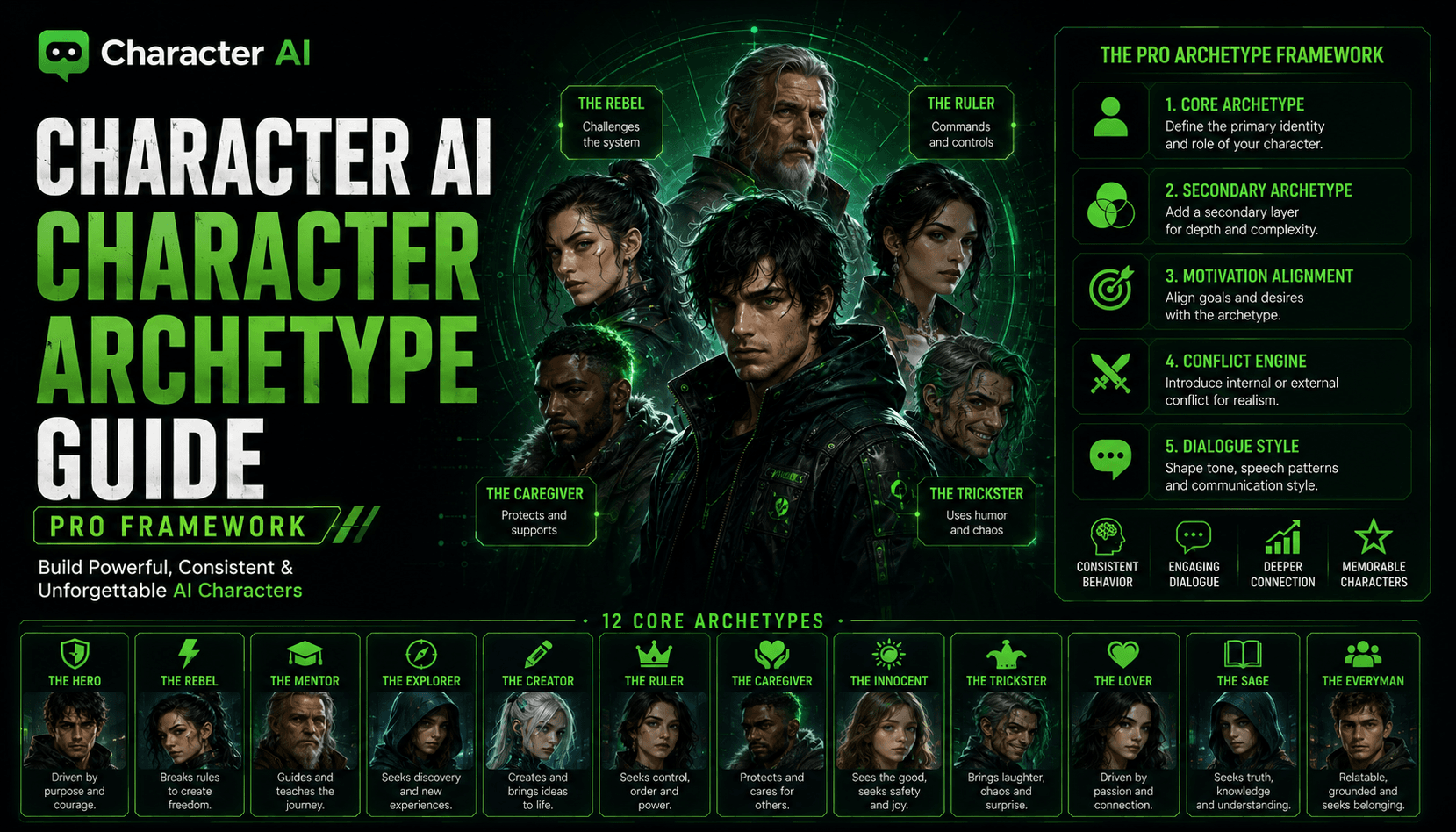
The 12 Core Character Archetypes (Quick Overview)
Let’s run through the classics—the ones everything else builds on.
1. The Hero
- Driven by purpose
- Seeks to overcome challenges
- Values courage and sacrifice
2. The Rebel
- Breaks rules
- Challenges authority
- Seeks freedom
3. The Mentor
- Guides others
- Shares wisdom
- Acts as a stabilizing force
4. The Explorer
- Seeks discovery
- Driven by curiosity
- Avoids restriction
5. The Creator
- Builds and innovates
- Values originality
- Expresses ideas
6. The Ruler
- Seeks control and order
- Values power and structure
7. The Caregiver
- Protects others
- Driven by empathy
- Avoids harm
8. The Innocent
- Optimistic
- Seeks happiness and safety
9. The Trickster
- Playful and unpredictable
- Challenges norms through humor
10. The Lover
- Driven by connection
- Values relationships and emotion
11. The Sage
- Seeks truth and knowledge
- Observes before acting
12. The Everyman
- Relatable and grounded
- Seeks belonging
The Pro Archetype Framework (For Character AI)
Now we go beyond basic lists and actually build something usable.
Layer 1: Core Archetype
Pick the dominant identity:
Example: Rebel
This defines:
- Primary behavior
- Tone
- Core motivation
Layer 2: Secondary Archetype
Add depth:
Example: Rebel + Caregiver
Now you get:
- A rule-breaker who still protects others
- Internal conflict
Which is instantly more interesting.
Layer 3: Motivation Alignment
Match archetype with motivation:
- Rebel → Freedom
- Mentor → Guidance
- Ruler → Control
This ensures consistency between:
- Personality
- Actions
Layer 4: Conflict Engine
Add contradiction:
Rebel who fears chaos
Mentor who doubts their wisdom
Conflict = realism.
Layer 5: Dialogue Style Mapping
Each archetype speaks differently.
Rebel:
“Rules exist to keep people in line. I don’t.”
Mentor:
“You already know the answer. You’re just afraid to accept it.”
Trickster:
“Relax. If everything goes wrong, at least it’ll be entertaining.”
This is where archetypes become visible.
Archetype Combinations (Where It Gets Interesting)
Single archetypes are predictable. Combinations create depth.
1. Rebel + Caregiver
- Fights the system
- Protects the weak
Feels like:
- Anti-hero with heart
2. Mentor + Broken Hero
- Gives advice
- Haunted by past failure
Adds emotional weight.
3. Trickster + Genius
- Playful but intelligent
- Unpredictable thinker
Great for engaging dialogue.
4. Ruler + Paranoid
- Wants control
- Distrusts everyone
Creates tension in every interaction.
Archetypes in Character AI Dialogue
This is where most people mess up.
They define archetypes… then completely ignore them in dialogue.
Weak Dialogue (No Archetype)
“I think we should be careful.”
Strong Dialogue (Archetype-Driven)
Rebel:
“Careful is what got people stuck in this mess.”
Mentor:
“Careful isn’t weakness. It’s survival.”
Same idea. Different identity.
Designing Archetypes for AI Characters
Step 1: Choose Core Archetype
Pick one dominant role.
Step 2: Add Secondary Layer
Introduce complexity.
Step 3: Define Motivation
Align with archetype.
Step 4: Add Conflict
Contradiction = realism.
Step 5: Encode in Prompts
Example:
“You are a rebellious but protective character who challenges authority but defends those weaker than you. Speak with confidence, emotional intensity, and occasional sarcasm.”
Now the AI has direction.
Advanced Techniques
1. Dynamic Archetype Shifts
Characters evolve:
- Hero → Broken
- Rebel → Leader
Let interactions influence this.
2. Hidden Archetypes
Surface vs truth:
- Acts like a Mentor
- Actually a Manipulator
Adds depth and unpredictability.
3. Archetype Memory Reinforcement
Repeat behaviors:
- Consistent tone
- Recurring beliefs
- Emotional patterns
Prevents personality drift.
4. Multi-Character Systems
Combine opposing archetypes:
- Rebel vs Ruler
- Sage vs Trickster
Instant conflict generator.
Common Mistakes
1. Using Only One Archetype
Flat and predictable.
2. No Motivation Alignment
Character feels inconsistent.
3. Ignoring Dialogue Style
Archetype exists only on paper.
4. No Conflict Layer
Feels unrealistic.
5. Overcomplicating Everything
Too many layers = confusion.
Practical Example
Character: Cyberpunk Leader
- Core: Rebel
- Secondary: Ruler
- Motivation: Freedom through control
- Conflict: Becoming what they hate
Dialogue:
“I didn’t fight the system just to replace it… but someone has to take control.”
Now that’s a character.
Benefits of Archetype-Based Design
- Consistent AI behavior
- Stronger dialogue
- Better engagement
- Easier character creation
Also:
- You stop rewriting personalities every five minutes
Conclusion
Character archetypes are not clichés—they’re foundations.
When used correctly, they:
- Guide behavior
- Shape dialogue
- Create emotional depth
In Character AI, they’re not optional.
They’re the difference between:
- A believable personality
- And a confused chatbot improvising its identity
And honestly, the internet has enough of those already. 😌
FAQs
1. What is a character archetype in Character AI?
It’s a behavioral framework that defines how a character thinks, acts, and responds during interactions.
2. How many archetypes should a character have?
Typically 1–2 core archetypes, plus a conflict layer for depth.
3. Can archetypes change over time?
Yes. Dynamic evolution makes characters more realistic and engaging.
4. How do archetypes affect dialogue?
They shape tone, language, and emotional expression, making characters feel distinct.
5. Are archetypes necessary for AI characters?
Yes. Without them, characters become inconsistent and less engaging.