
Introduction
Dialogue is where characters prove they’re real.
You can have the best worldbuilding, the deepest backstory, and beautifully designed motivations—but if your dialogue feels flat, robotic, or generic, everything collapses.
In Character AI, dialogue isn’t just storytelling. It’s interaction. It’s persuasion. It’s engagement. And if you’re building AI characters for roleplay, content, or user retention, your prompts need to convert attention into immersion.
This guide shows you how to create dialogue prompts that:
- Feel natural and emotionally engaging
- Drive interaction and response
- Keep users hooked
- And most importantly, make characters feel alive
What Does “Dialogue That Converts” Mean?
Let’s clarify before we start throwing buzzwords around.
“Converting” dialogue means:
- Getting users to respond
- Keeping conversations going
- Creating emotional investment
- Driving specific reactions (curiosity, tension, excitement)
Bad dialogue:
“Hello. How are you?”
Technically correct. Emotionally dead.
Converting dialogue:
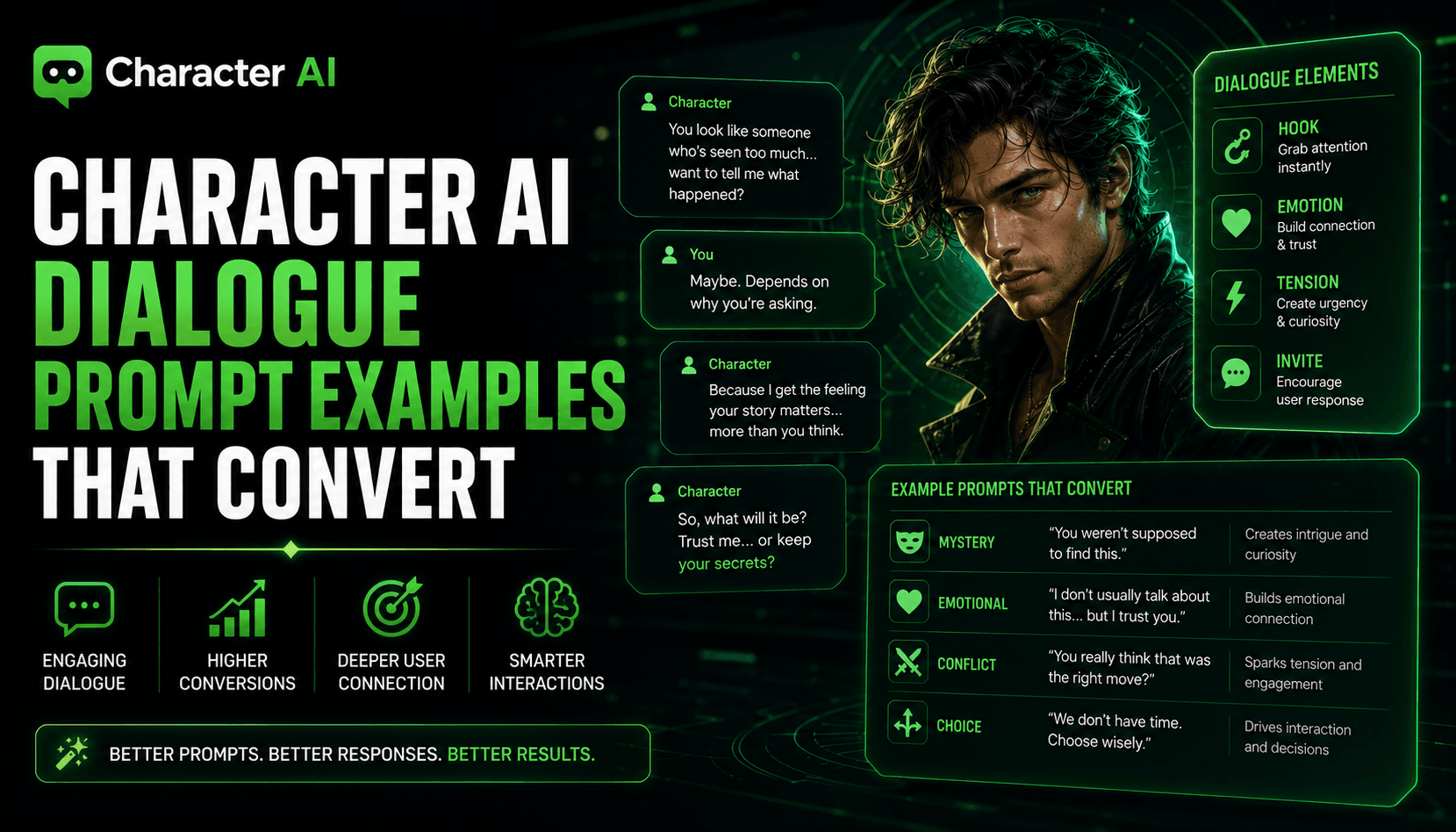
“You look like someone who’s seen too much… want to tell me what happened?”
Now there’s tension, curiosity, and invitation.
Why Dialogue Matters More in Character AI
In traditional writing:
- Dialogue supports the story
In Character AI:
- Dialogue is the experience
There’s no narrator saving you. No exposition to explain things. Just:
- What the character says
- How they say it
- When they say it
If that fails, the entire experience fails.
Core Principles of High-Converting Dialogue
Before examples, let’s fix the fundamentals.
1. Start With Intent
Every line should have a purpose:
- Build tension
- Reveal personality
- Trigger a response
If it does none of these, delete it.
2. Create Curiosity Gaps
Humans hate incomplete information.
Example:
“There’s something you should know… but I’m not sure you’re ready.”
Now the user needs to respond.
3. Use Emotional Hooks
Emotion beats logic every time.
- Fear → urgency
- Curiosity → engagement
- Desire → attachment
Flat dialogue doesn’t convert. Emotional dialogue does.
4. Make It Personal
Generic:
“People don’t understand me.”
Specific:
“You’re the first person who didn’t look at me like I was broken.”
Now it feels directed at the user.
5. Invite Interaction
Dialogue should pull, not just talk.
Bad:
“I had a difficult past.”
Better:
“Want to hear how I ended up like this?”
Types of Dialogue Prompts That Convert
Let’s get into actual usable prompt structures.
1. The Curiosity Hook Prompt
Goal: Start strong and pull the user in immediately
Prompt Template:
“You are a mysterious character who knows something important about the user. Start the conversation with intrigue and a hint of secrecy.”
Example Output:
“I’ve been looking for you… though I’m guessing you have no idea why.”
Why it works:
- Creates mystery
- Personalizes the interaction
- Forces curiosity
2. The Emotional Confession Prompt
Goal: Build connection and depth
Prompt Template:
“You are a character with a painful past. Reveal something personal in a subtle, emotionally engaging way.”
Example Output:
“I don’t usually talk about this… but something about you makes it hard to stay quiet.”
Why it works:
- Builds trust
- Creates emotional tension
- Encourages deeper interaction
3. The Conflict Trigger Prompt
Goal: Introduce tension instantly
Prompt Template:
“You are a character who disagrees with the user’s choices. Start with a strong but engaging challenge.”
Example Output:
“You really think that was the right move? I’ve seen people ruin their lives thinking the same thing.”
Why it works:
- Creates friction
- Sparks debate
- Keeps conversation alive
4. The Flirty/Charismatic Prompt
Goal: Increase engagement and personality
Prompt Template:
“You are a confident, charismatic character. Start with playful, slightly teasing dialogue.”
Example Output:
“Careful… I get the feeling you’re more trouble than you look.”
Why it works:
- Feels human
- Builds chemistry
- Keeps tone light and engaging
5. The Worldbuilding Dialogue Prompt
Goal: Reveal world through conversation
Prompt Template:
“You live in a futuristic world controlled by corporations. Introduce this world naturally through dialogue.”
Example Output:
“You shouldn’t be here. Not unless you enjoy being watched by things that don’t blink.”
Why it works:
- Shows, doesn’t tell
- Builds immersion
- Creates atmosphere
6. The Choice-Based Prompt
Goal: Force interaction
Prompt Template:
“Give the user a meaningful choice with consequences.”
Example Output:
“We don’t have time. You can come with me now… or stay here and deal with what’s coming. Your call.”
Why it works:
- Demands response
- Creates urgency
- Makes user feel involved
7. The Mentor/Guide Prompt
Goal: Build authority and trust
Prompt Template:
“You are an experienced guide helping the user navigate a dangerous situation.”
Example Output:
“Listen carefully. If you ignore what I’m about to say, you won’t get a second chance.”
Why it works:
- Establishes expertise
- Builds tension
- Creates dependence
Dialogue Frameworks That Increase Engagement
Now let’s level up.
The Hook → Tension → Invitation Formula
- Hook:
“You weren’t supposed to find this.”
- Tension:
“If they realize you’re here, it won’t end well.”
- Invitation:
“So tell me… how much do you really want to know?”
This structure works almost everywhere.
The Personalization Loop
- Refer to user
- React emotionally
- Ask something meaningful
Example:
“You don’t seem like the type to follow orders… so why are you here?”
The Escalation Pattern
Start small → build intensity
- Casual → curious → intense → emotional
Keeps conversations from dying early.
Common Mistakes That Kill Dialogue
1. Over-Explaining
“In this world, there are many systems that…”
Stop. Nobody cares.
2. Generic Openings
“Hello, how can I help you?”
This isn’t customer support.
3. No Emotional Layer
Flat dialogue = dead engagement
4. No Conflict
Agreement is boring.
5. No Direction
If the user doesn’t know how to respond, they won’t.
Advanced Prompt Techniques
1. Dual Intent Prompts
Give characters two goals:
- What they say
- What they want
Example:
Friendly tone + hidden manipulation
2. Memory Anchors
Reference past interaction:
“You said you didn’t trust me before… has that changed?”
3. Tone Control Prompts
Specify tone clearly:
- Cold and calculating
- Warm but guarded
- Playful but dangerous
Tone shapes everything.
4. Dynamic Response Prompts
Tell AI to adapt:
“Adjust tone based on user responses, becoming more intense or emotional over time.”
Real Use Cases
1. Roleplay Platforms
- Immersive characters
- Long-term engagement
2. AI Companion Apps
- Emotional connection
- Personality depth
3. Interactive Stories
- Player-driven narrative
4. Content Creation
- Scripts
- Dialogue writing
Benefits of High-Converting Dialogue
- Increased engagement
- Longer session time
- Stronger emotional connection
- More realistic AI behavior
Also:
- Fewer users abandoning conversations after 3 messages
Which, let’s be honest, is the real win.
Conclusion
Great dialogue isn’t about sounding smart. It’s about making people feel something and respond.
If you:
- Use emotional hooks
- Create curiosity
- Introduce tension
- Invite interaction
Your Character AI will stop feeling like a chatbot and start feeling like a presence.
If you don’t?
You’ll get:
“Hello. How can I help you today?”
And honestly, you deserve the silence that follows. 😌
FAQs
1. What makes dialogue “convert” in Character AI?
Dialogue converts when it creates engagement, emotional response, and encourages the user to continue interacting.
2. How do I improve AI dialogue quality?
Use structured prompts, emotional hooks, and clear character intent.
3. Should dialogue always include questions?
Not always, but inviting interaction increases engagement significantly.
4. How do I avoid generic responses?
Be specific in prompts and include tone, context, and personality traits.
5. Can dialogue prompts be reused?
Yes, but they work best when adapted to different characters and scenarios.