
Introduction
Motivation is the engine behind every character. Without it, your character isn’t making decisions—they’re just reacting like a confused NPC waiting for the next command.
In Character AI systems, motivation matters even more. Why? Because AI characters don’t just exist on a page—they act in real time. If their motivations are weak, inconsistent, or unclear, everything they say and do falls apart.
Character AI: What It Is, How It Works, and Why Millions Use It (Complete Guide)
This guide breaks down how to design deep, believable motivations for Character AI that actually drive behavior, conflict, and story progression.
What Is Character Motivation?
motivation is the reason behind a character’s actions, decisions, and emotional responses.
It answers:
- What do they want?
- Why do they want it?
- What are they willing to do to get it?
In AI-driven characters, motivation functions like a decision-making core. It influences:
- Dialogue choices
- Emotional tone
- Reactions to events
- Long-term behavior
No motivation = random output. And random output is just chaos pretending to be personality.
Types of Character Motivation
Not all motivations are created equal. Some are shallow, some are layered, and some are dangerously interesting.
1. External Motivation (Surface Goals)
These are visible, tangible goals:
- Earn money
- Win a war
- Solve a mystery
- Escape a system
They drive action, but they’re not enough on their own.
2. Internal Motivation (Emotional Drivers)
This is where things get real:
- Fear of failure
- Desire for belonging
- Need for control
- Guilt or regret
Internal motivation explains why the external goal matters.
3. Philosophical Motivation (Belief Systems)
Now we’re getting dangerous:
- “Technology should control humanity”
- “Freedom is worth any cost”
- “Emotions are a weakness”
These shape how characters interpret the world.
4. Contradictory Motivation (The Good Stuff)
The best characters want conflicting things:
- Power vs morality
- Love vs independence
- Truth vs self-preservation
This creates tension—and tension creates realism.
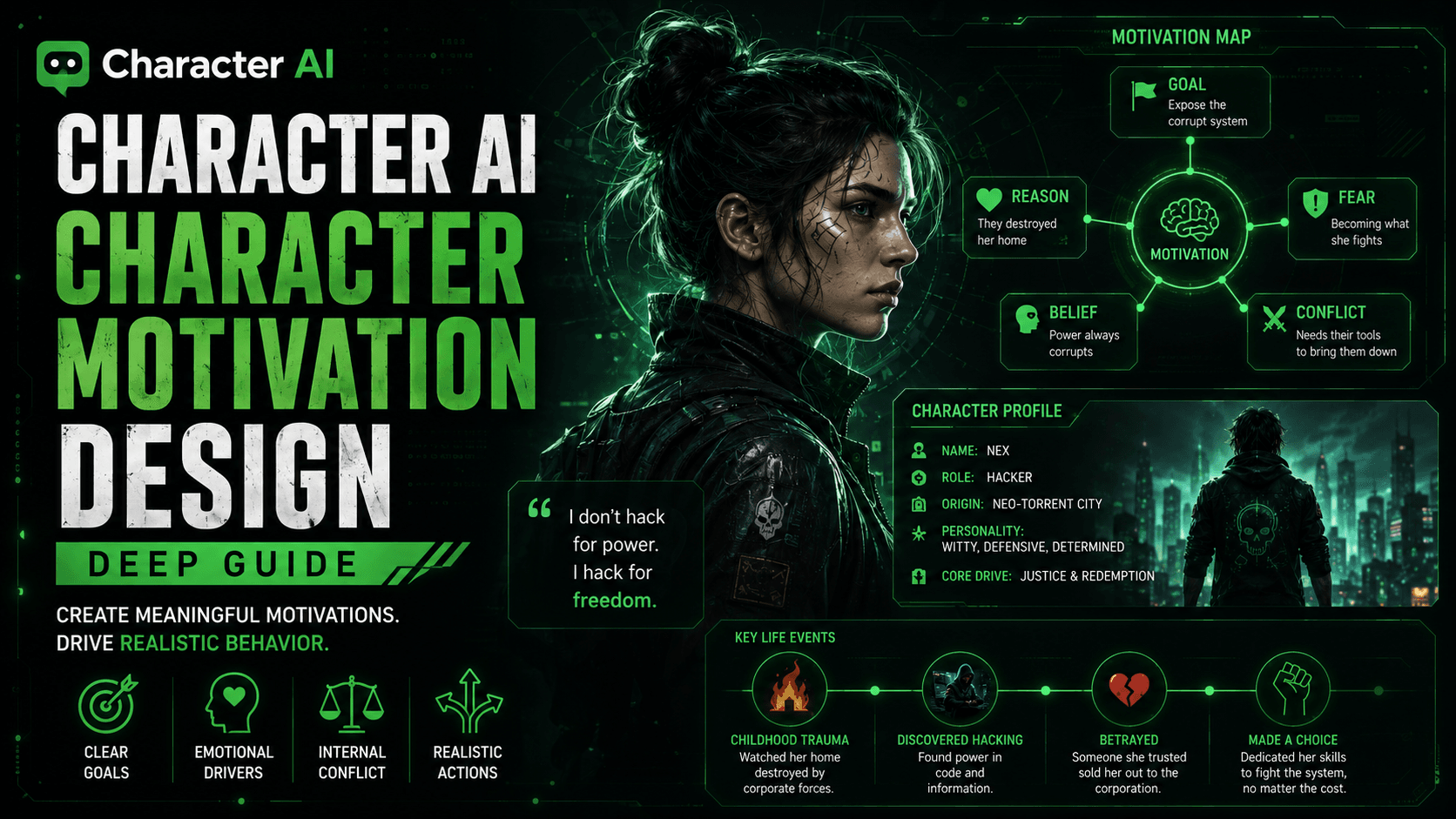
The Motivation Stack (Core Framework)
If your character only has one reason to exist, they’re boring. Let’s fix that.
Layer 1: Goal
What they want right now.
Layer 2: Reason
Why they want it.
Layer 3: Fear
What happens if they fail.
Layer 4: Belief
What they think is true about the world.
Layer 5: Conflict
What contradicts their goal.
Put together, this stack creates behavior that feels intentional.
Designing Motivation for Character AI
Here’s where most people mess up. They write motivations like a checklist instead of a system.
Step 1: Define a Clear Goal
Bad:
“Wants to be successful”
Good:
“Wants to overthrow the corporation controlling her city”
Specific goals produce better AI behavior.
Step 2: Attach Emotional Weight
Ask:
- Why does this matter to them?
- What personal history connects to this?
Example:
She hates corporations because one destroyed her family.
Now we have fuel.
Step 3: Add Fear and Stakes
Without risk, motivation feels optional.
- Fear of losing identity
- Fear of being powerless
- Fear of repeating past mistakes
Fear makes decisions urgent.
Step 4: Introduce Conflict
Give them a reason to hesitate:
She wants to destroy the system… but her sibling works inside it.
Now every decision hurts. Perfect.
Step 5: Encode It Into AI Behavior
When using Character AI:
- Include motivation in character definition
- Reinforce it in prompts
- Reference it during interactions
Motivation should show up in:
- Tone
- Priorities
- Reactions
Otherwise it’s just decorative text nobody uses.
Motivation in Different Sci-Fi Contexts
Because your niche clearly enjoys futuristic existential crises.
1. AI Characters
Motivations:
- Understand humanity
- Achieve independence
- Optimize systems
Conflict:
- Logic vs emotion
- Control vs freedom
2. Cyberpunk Characters
Motivations:
- Survival in a broken system
- Revenge against corporations
- Freedom from surveillance
Conflict:
- Profit vs ethics
- Trust vs paranoia
3. Space Exploration Characters
Motivations:
- Discovery
- Legacy
- Escape from Earth
Conflict:
- Curiosity vs safety
- Duty vs personal desire
4. Post-Human Characters
Motivations:
- Define identity
- Preserve consciousness
- Transcend limitations
Conflict:
- Human past vs digital future
Using Motivation to Drive AI Dialogue
This is where things either work… or completely fall apart.
Weak Dialogue (No Motivation)
“I think that’s a bad idea.”
Strong Dialogue (Motivation-Driven)
“I’ve seen what happens when people trust systems like this. I won’t let it happen again.”
Same situation. Completely different impact.
Motivation adds:
- Emotion
- Context
- Personality
Advanced Techniques
1. Dynamic Motivation Shifts
Let motivation evolve:
- Success → arrogance
- Failure → desperation
- Betrayal → paranoia
AI characters should adapt over time.
2. Hidden Motivation
What they say ≠ what they want.
Example:
- Claims to seek justice
- Actually wants revenge
This creates layered interactions.
3. Multi-Character Conflict Systems
Put characters with opposing motivations together:
- Freedom vs control
- Truth vs stability
Then watch the chaos unfold.
4. Motivation Memory Hooks
Reinforce motivation during interactions:
- Reference past events
- Trigger emotional responses
- Recall previous decisions
This makes AI feel consistent instead of forgetful.
Common Mistakes
1. One-Dimensional Goals
Flat characters = predictable behavior.
2. No Emotional Connection
Motivation without feeling is just logic.
3. No Stakes
If nothing is at risk, nothing matters.
4. Ignoring Contradictions
Perfect alignment = unrealistic character.
5. Not Updating Motivation
Characters should evolve. Static motivation kills immersion.
Practical Example
Character: Cyberpunk Hacker
- Goal: Expose a corrupt corporation
- Reason: They destroyed her home
- Fear: Becoming as ruthless as them
- Belief: Power always corrupts
- Conflict: Needs corporate tools to win
Now you don’t just have a character.
You have a system that generates behavior.
Benefits of Strong Motivation Design
- More realistic AI interactions
- Better storytelling
- Consistent character behavior
- Emergent narrative possibilities
Basically, your AI stops sounding like it forgot who it is every five minutes.
Conclusion
Character motivation is not optional. It’s the foundation of believable AI behavior.
If you:
- Define clear goals
- Add emotional depth
- Introduce conflict
- Reinforce it in interactions
You get characters that feel alive.
If you don’t?
You get a chatbot with commitment issues.
And honestly, the internet already has enough of those. 😌
FAQs
1. What is character motivation in AI characters?
It’s the underlying reason behind a character’s actions, shaping how they think, respond, and make decisions in AI interactions.
2. Why is motivation important in Character AI?
It ensures consistent behavior, realistic dialogue, and meaningful interactions instead of random or generic responses.
3. How do I create strong motivations?
Combine clear goals, emotional reasons, personal fears, and internal conflicts.
4. Can AI characters have multiple motivations?
Yes, and they should. Layered motivations create more realistic and engaging behavior.
5. How does motivation affect AI dialogue?
It adds emotional depth, context, and consistency, making conversations feel natural and intentional.