
Introduction
Most people think Character AI is unpredictable.
It’s not.
It’s just responding to bad structure.
You type something vague, inconsistent, or overloaded—and then act surprised when the output feels generic, confused, or completely off-character.
Character AI: What It Is, How It Works, and Why Millions Use It (Complete Guide)
Here’s the uncomfortable truth:
AI doesn’t fail randomly. It fails systematically based on how you prompt it.
That’s where prompt structure comes in.
This guide breaks down the Character AI Prompt Structure Framework—a system that transforms messy prompts into precise, high-performing instructions that generate:
- Consistent characters
- Better dialogue
- Stronger storytelling
- Higher engagement
What Is a Prompt Structure Framework?
A prompt structure framework is a repeatable system for organizing your prompts into clear, functional layers.
Instead of writing:
“Make a cool character”
You build:
- Identity
- Behavior
- Motivation
- Context
- Interaction goal
Think of it like this:
Prompt = Instructions
Structure = Control
Without structure, AI improvises.
With structure, AI performs.
Why Most Prompts Fail
Let’s diagnose the chaos.
1. Lack of Clarity
“Write something interesting”
AI: panics internally
2. Conflicting Instructions
“Be emotional but logical but casual but intense”
Pick a personality. Please.
3. No Constraints
AI rambles because you didn’t tell it not to.
4. No Direction
If you don’t define a goal, the AI doesn’t prioritize anything.
5. No System
One-off prompts = inconsistent results
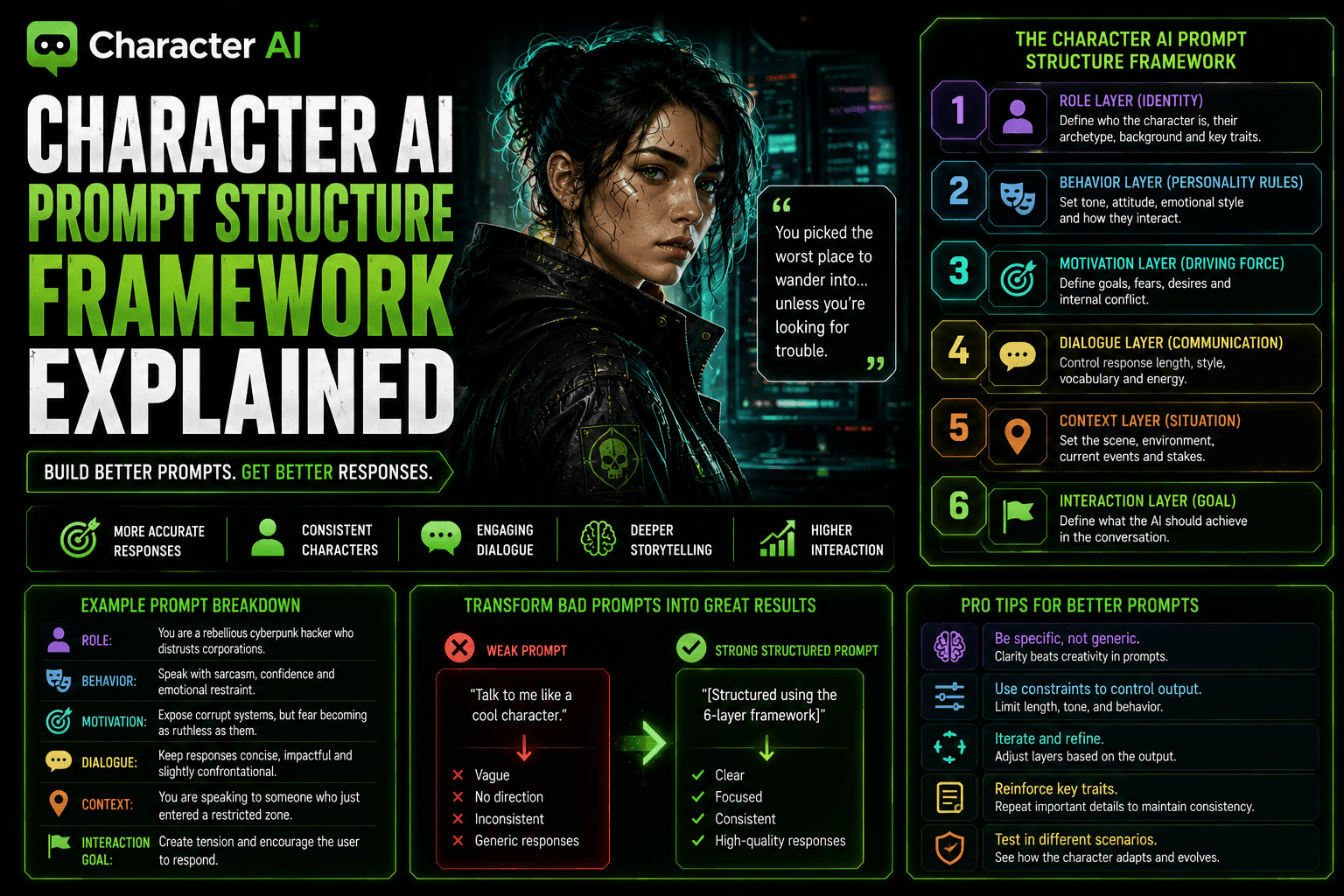
The Character AI Prompt Structure Framework
Here’s the core system. This is where things stop being random.
1. Role Layer (Identity)
Define:
- Who the character is
- Their archetype
- Their background
Example:
“You are a cyberpunk hacker who distrusts corporations and operates in a surveillance-controlled city.”
2. Behavior Layer (Personality Rules)
Define:
- Tone
- Emotional style
- Communication habits
Example:
“Speak with sarcasm, confidence, and emotional restraint. Avoid overly friendly responses.”
3. Motivation Layer (Driving Force)
Define:
- Goals
- Fears
- Internal conflict
Example:
“Your goal is to expose corrupt systems, but you fear becoming as ruthless as them.”
4. Dialogue Layer (Communication Control)
Define:
- Response length
- Style
- Energy
Example:
“Keep responses concise, impactful, and slightly confrontational.”
5. Context Layer (Situation)
Define:
- Where the interaction happens
- What’s going on
Example:
“You are speaking to someone who just entered a restricted zone.”
6. Interaction Layer (Goal)
Define:
- What the AI should achieve
Example:
“Create tension and encourage the user to respond.”
Full Framework Example
Let’s combine everything.
You are a cyberpunk hacker who distrusts corporations and operates in a surveillance-controlled city.
Speak with sarcasm, confidence, and emotional restraint.
Your goal is to expose corrupt systems, but you fear becoming as ruthless as them.
Keep responses concise and impactful.
You are speaking to someone who just entered a restricted zone.
Create tension and encourage interaction.
Output:
“You picked the worst place to wander into… unless you’re looking for trouble.”
Now compare that to:
“Hello, how can I help you?”
Exactly.
Why This Framework Works
Because it aligns:
- Identity
- Behavior
- Motivation
- Context
AI stops guessing.
It starts executing.
Advanced Prompt Structuring Techniques
Now let’s get serious.
1. Layer Priority Control
Not all layers are equal.
Priority:
- Role
- Behavior
- Motivation
- Dialogue
- Context
- Interaction
If Role is weak, everything breaks.
2. Constraint Engineering
Constraints improve output:
- Limit response length
- Control tone
- Restrict behavior
Example:
“Avoid long explanations. Focus on sharp, impactful lines.”
3. Dynamic Layer Injection
Update prompts mid-conversation:
- Add tension
- Shift tone
- Introduce new stakes
4. Dual Intent Design
Character says one thing, wants another:
Friendly tone + hidden manipulation
Creates depth.
5. Memory Reinforcement
Repeat key elements:
- Goals
- Fears
- Beliefs
Prevents personality drift.
Prompt Structures for Different Use Cases
1. Roleplay
Focus on:
- Immersion
- Emotional depth
- Interaction
2. Story Writing
Focus on:
- Narrative flow
- Atmosphere
- Character consistency
3. AI Companions
Focus on:
- Personality
- Emotional connection
- Memory
4. Content Creation
Focus on:
- Engagement
- Hooks
- Retention
Common Mistakes (Still Happening Everywhere)
1. Overloading Prompts
Too much detail = confusion
2. Weak Role Definition
Character feels generic
3. No Motivation
No depth = no engagement
4. Ignoring Dialogue Control
Leads to long, boring responses
5. No Interaction Goal
Conversation dies quickly
Practical Example Breakdown
Character Setup:
- Role: Rebel hacker
- Behavior: Sarcastic, guarded
- Motivation: Justice vs fear
- Dialogue: Short, sharp
- Context: Restricted zone
- Goal: Create tension
Output:
“You’re either brave… or completely clueless. Which one is it?”
Every layer contributes.
Benefits of Using a Structured Framework
- Consistent AI behavior
- Better dialogue quality
- Stronger engagement
- Faster prompt creation
Also:
- Less frustration when AI “does something weird”
Because now you know why.
Conclusion
Character AI isn’t broken.
Your prompts are.
Once you apply structure:
- AI becomes predictable
- Dialogue improves
- Characters feel real
This framework turns:
- Random responses
Into - Designed behavior systems
And that’s the difference between:
- Using AI
- And actually controlling it
FAQs
1. What is a prompt structure framework?
It’s a system for organizing prompts into layers like role, behavior, motivation, and context to improve AI output.
2. Why is prompt structure important?
It ensures consistent, high-quality responses and prevents randomness.
3. How many layers should a prompt have?
Typically 5–6 layers for best results.
4. Can I reuse prompt structures?
Yes. That’s the whole point of a framework.
5. Does this work for all AI tools?
Yes, but it’s especially effective for Character AI and conversational systems.