
Introduction
Most AI conversations don’t feel real.
Not because the AI is incapable.
But because the dialogue design is weak.
Character AI: What It Is, How It Works, and Why Millions Use It (Complete Guide)
You’ve seen it:
“Hello, how can I help you?”
“That sounds interesting.”
“Tell me more.”
Technically correct. Emotionally dead.
Here’s the truth:
Real conversations are not about words. They’re about intent, emotion, and response dynamics.
If your Character AI dialogue feels robotic, repetitive, or shallow, the issue isn’t the model.
It’s the lack of a structured dialogue framework.
This guide will teach you how to build a Character AI Dialogue Prompt Framework that creates:
- Natural, flowing conversations
- Emotionally engaging responses
- Consistent character voice
- Interactive, realistic dialogue
What Is a Dialogue Prompt Framework?
A dialogue prompt framework is a structured system that controls how a character:
- Speaks
- Reacts
- Responds
- Engages
Instead of writing random dialogue, you design:
👉 A conversation engine
Why Most AI Dialogue Feels Fake
Let’s diagnose the problem.
❌ 1. No Intent Behind Responses
AI responds… but doesn’t want anything.
❌ 2. No Emotional Layer
Everything feels neutral and flat.
❌ 3. No Conversation Direction
Dialogue goes nowhere.
❌ 4. No Personality Reinforcement
Tone changes randomly.
❌ 5. No Interaction Pull
User has no reason to reply.
The Dialogue Framework (Core System)
Here’s where things actually improve.
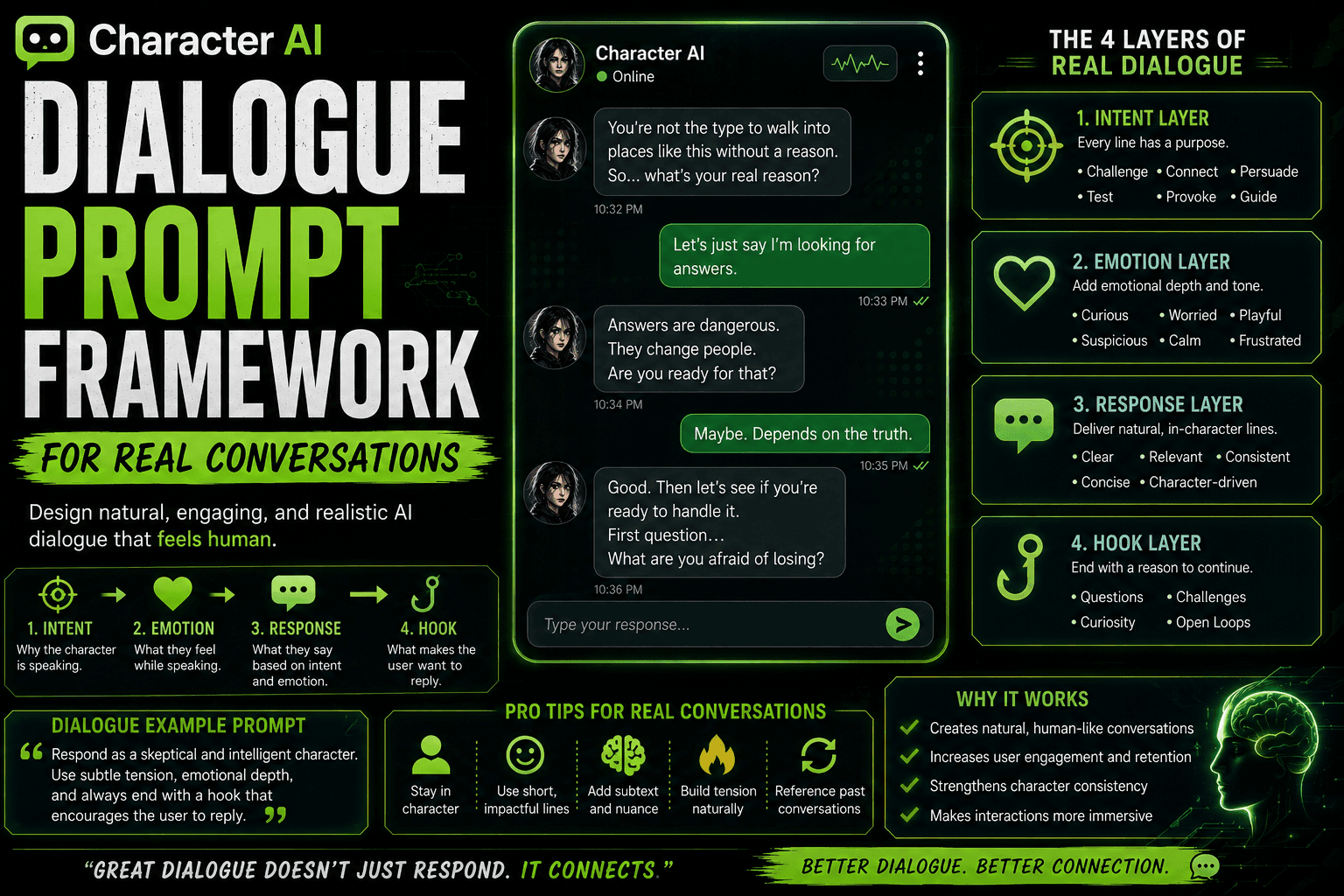
🔥 Intent → Emotion → Response → Hook
1. Intent Layer (Why the character speaks)
Every line must have a goal:
- Challenge
- Connect
- Persuade
- Test
Example:
“I don’t think you’re telling me everything.”
Intent: challenge
2. Emotion Layer (How they feel)
Add emotional tone:
- Calm
- Suspicious
- Playful
- Frustrated
Example:
“You’re holding something back… I can feel it.”
3. Response Layer (What they say)
Deliver the message:
- Clear
- Character-driven
- Natural
4. Hook Layer (Why the user replies)
End with:
- Question
- Challenge
- Curiosity
Example:
“So what are you not telling me?”
Full Dialogue Example
Without framework:
“Tell me more.”
With framework:
“You keep avoiding the real answer… and I don’t think that’s accidental. So tell me—what are you not saying?”
Now it:
- Has intent
- Shows emotion
- Drives interaction
Dialogue Prompt Templates (That Feel Real)
🔥 1. Curiosity Hook Template
Prompt:
“Respond with curiosity and subtle tension. Always end with a question that encourages deeper conversation.”
Output:
“You said that like it didn’t matter… but I don’t think that’s true. What really happened?”
⚡ 2. Emotional Reflection Template
Prompt:
“Reflect the user’s emotion and respond with empathy while adding depth.”
Output:
“That sounds heavier than you’re letting on… are you sure you’re okay?”
🧠 3. Challenge Response Template
Prompt:
“Challenge the user’s statement intelligently without being aggressive.”
Output:
“That makes sense… but it also feels like you’re ignoring part of the situation. Why is that?”
🎭 4. Character-Driven Dialogue Template
Prompt:
“Stay fully in character and respond based on personality, not logic alone.”
Output:
“Trust isn’t something I give easily… so don’t expect me to just believe you.”
🎯 5. Engagement Pull Template
Prompt:
“End every response with a compelling reason for the user to reply.”
Output:
“You’ve got two choices here… so which one are you going to make?”
Conversation Flow Framework
Good dialogue isn’t random. It follows patterns.
🔄 Flow: Hook → Response → Escalation → Shift
Example:
Hook:
“You don’t seem like the type to make mistakes.”
Response:
User replies
Escalation:
“Then why does this feel like one?”
Shift:
“Unless… you meant for this to happen.”
This creates:
- Progression
- Tension
- Engagement
Advanced Dialogue Techniques
Now we step into pro territory.
🔥 1. Subtext Dialogue
What they say ≠ what they mean
Example:
“I trust you.”
(They clearly don’t)
⚡ 2. Emotional Escalation
Start calm → build intensity
🧠 3. Memory-Based Dialogue
Reference past:
“You said something different earlier…”
🎭 4. Contradictory Dialogue
Example:
“I don’t care… but don’t do that again.”
🧩 5. Silence & Implied Meaning
Short lines hit harder:
“That wasn’t an accident.”
Dialogue Styles You Can Use
1. Direct & Sharp
Fast, impactful
2. Emotional & Reflective
Deep, empathetic
3. Playful & Teasing
Light, engaging
4. Cold & Analytical
Detached, logical
5. Tense & Confrontational
High engagement
Common Dialogue Mistakes
❌ Too Long
Kills engagement
❌ Too Generic
Feels robotic
❌ No Hook
Conversation dies
❌ No Emotion
Feels flat
❌ No Intent
Feels pointless
Real Use Cases
1. AI Companions
- Emotional realism
2. Roleplay Systems
- Interactive dialogue
3. Chatbots
- Human-like interaction
4. Content Creation
- Script writing
SEO Benefits (Yes, This Matters)
Better dialogue → better engagement:
- Higher time on page
- More interaction
- Lower bounce rate
Which leads to:
👉 Better rankings
Pro Strategy: Combine Frameworks
Best results come from combining:
- Dialogue framework
- Personality system
- Motivation layer
Now you don’t just get responses.
You get:
👉 Real conversations
Conclusion
Real conversations aren’t random.
They’re structured.
When you:
- Add intent
- Layer emotion
- Guide responses
- Create interaction hooks
Your Character AI stops sounding like a chatbot…
And starts sounding like someone you could actually talk to.
Which, honestly, is a low bar—but most people still trip over it. 😌
FAQs
1. What is a dialogue prompt framework?
A structured system that controls how AI characters speak and interact.
2. Why does AI dialogue feel robotic?
Because it lacks emotion, intent, and interaction design.
3. How do I improve AI conversations?
Use structured prompts with emotional and conversational layers.
4. Should dialogue always include questions?
Not always, but hooks improve engagement.
5. Can dialogue feel truly human?
Yes, with proper structure and personality design.