
Introduction
Storytelling with Character AI isn’t about writing everything yourself.
It’s about guiding the story without controlling every detail.
That’s where most creators struggle.
Character AI: What It Is, How It Works, and Why Millions Use It (Complete Guide)
They either:
- Overwrite everything (and kill spontaneity)
- Or under-guide the AI (and get generic chaos)
The result?
Stories that feel:
- Flat
- Inconsistent
- Forgettable
Here’s the reality:
Great AI storytelling comes from structured narrative prompts, not random creativity.
This guide will show you how to use Character AI narrative prompt examples to:
- Build immersive story worlds
- Create dynamic character-driven plots
- Maintain narrative consistency
- Generate compelling dialogue and progression
What Is a Narrative Prompt?
A narrative prompt is a story-driven instruction that guides AI to:
- Create scenes
- Develop characters
- Move plots forward
Unlike basic prompts, narrative prompts include:
- Setting
- Character perspective
- Emotional tone
- Story direction
Think of it like this:
Prompt = instruction
Narrative prompt = storytelling system
Why Most AI Stories Fail
Let’s address the chaos.
❌ No Structure
Random scenes with no direction.
❌ Weak Characters
No personality = no story.
❌ No Conflict
Nothing at stake = no engagement.
❌ Over-Control
Kills creativity and spontaneity.
❌ No Narrative Flow
Scenes don’t connect.
The Narrative Prompt Framework
This is your foundation.
🔥 Setting → Character → Conflict → Progression
Example:
“The storm batters the city as power flickers. (Setting)
You are a detective who hasn’t slept in days. (Character)
A case resurfaces—one you thought was closed. (Conflict)
As you step into the crime scene, something feels wrong. (Progression)”
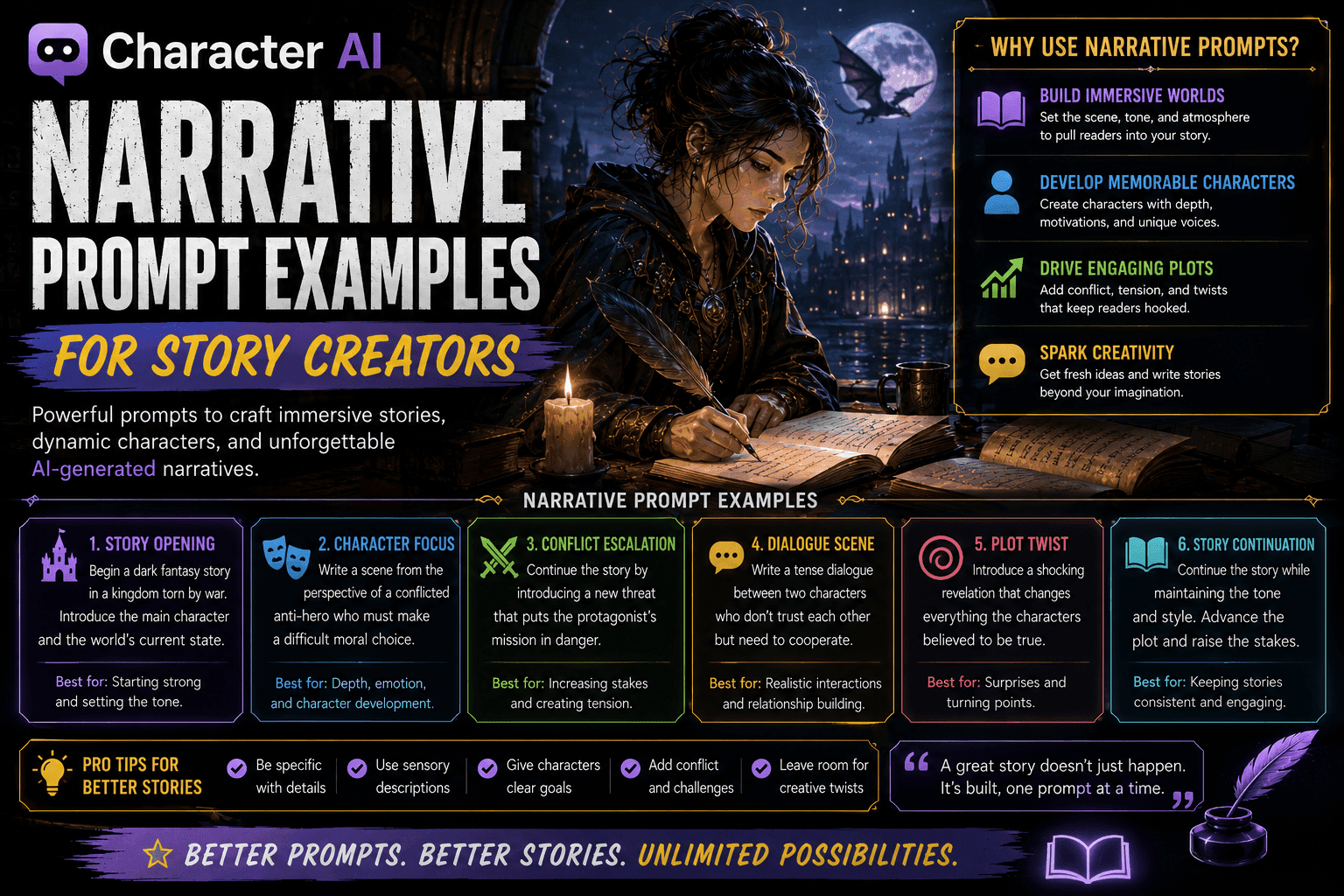
High-Impact Narrative Prompt Examples
🎭 1. Story Opening Prompt
Use for: Starting a narrative
Prompt:
“Begin a dark, cinematic story set in a futuristic city. Focus on atmosphere, tension, and introduce a main character with a troubled past.”
Output:
“Rain fell like static against the neon skyline. He hadn’t meant to come back—but some things don’t stay buried.”
⚡ 2. Character-Driven Scene Prompt
Use for: Deep character storytelling
Prompt:
“Write a scene from the perspective of a conflicted anti-hero who is forced to make a difficult moral choice.”
Why it works:
- Focuses on emotion
- Builds depth
- Drives story
🧠 3. Conflict Escalation Prompt
Use for: Increasing tension
Prompt:
“Continue the story by introducing a complication that forces the main character into a high-risk situation.”
🎯 4. Dialogue-Focused Narrative Prompt
Use for: Character interaction
Prompt:
“Write a tense dialogue between two characters who don’t trust each other but need to work together.”
🎬 5. Scene Expansion Prompt
Use for: Adding detail
Prompt:
“Expand this scene with sensory details, emotional tension, and environmental description.”
🧩 6. Plot Twist Prompt
Use for: Surprise elements
Prompt:
“Introduce a plot twist that changes the reader’s understanding of the story.”
🚀 7. Story Continuation Prompt
Use for: Maintaining flow
Prompt:
“Continue the story while maintaining tone, character consistency, and increasing stakes.”
Narrative Prompt Templates (Copy & Use)
Template 1 (Basic Story Start)
“Write a story set in [setting] about a [character] facing [conflict]. Focus on [tone].”
Template 2 (Character Perspective)
“Write a scene from the perspective of a [character type] who is dealing with [internal conflict].”
Template 3 (Advanced Narrative Control)
“Continue the story with a focus on [emotion], introduce [new conflict], and maintain [tone/style].”
Building Story Flow with AI
Let’s connect everything.
Step 1: Start Strong
Use a cinematic opening.
Step 2: Introduce Conflict
Give the story direction.
Step 3: Develop Characters
Let them evolve.
Step 4: Escalate Stakes
Increase tension.
Step 5: Deliver Payoff
Resolve or twist.
Advanced Narrative Techniques
Now we get into pro territory.
🔥 1. Multi-Perspective Storytelling
Switch viewpoints:
- Hero
- Villain
- Observer
⚡ 2. Emotional Layering
Combine:
- External conflict
- Internal struggle
🧠 3. Controlled Chaos
Give AI room to surprise you:
- Don’t over-specify
🎭 4. Narrative Memory Anchors
Reference past:
“The same symbol appeared again…”
🧩 5. Theme Reinforcement
Repeat ideas:
- Power
- Trust
- Identity
Common Mistakes
❌ Over-Directing AI
Kills creativity.
❌ No Character Depth
Flat storytelling.
❌ Ignoring Tone
Breaks immersion.
❌ No Progression
Story feels stuck.
❌ No Stakes
Nothing matters.
Use Cases for Narrative Prompts
1. Fiction Writing
- Novels
- Short stories
2. Roleplay Systems
- Interactive storytelling
3. Content Creation
- Scripts
- Story content
4. Game Development
- Narrative design
SEO Benefits (Yes, Storytelling Helps)
Narrative content improves:
- Engagement
- Time on page
- User retention
Which leads to:
👉 Better rankings
Pro Strategy: Combine Everything
Best results come from:
- Narrative prompts
- Personality frameworks
- Dialogue systems
Now you’re not prompting.
You’re building a story engine.
Conclusion
Character AI storytelling isn’t about control.
It’s about guidance + structure + creativity.
When you:
- Use strong narrative prompts
- Build real characters
- Maintain story flow
You create something powerful:
👉 Stories that feel alive
And honestly?
That’s the whole point.
FAQs
1. What are narrative prompts?
Prompts designed to guide storytelling and plot development.
2. How do I improve AI storytelling?
Use structured prompts with setting, character, and conflict.
3. Can AI write full stories?
Yes, but guidance improves quality.
4. What makes a good story prompt?
Clear direction, emotion, and conflict.
5. Should I control everything?
No—leave room for creativity.