
Introduction
Dialogue is where stories either become immersive… or collapse into two characters politely exchanging information like corporate coworkers trapped in a meeting room.
Good dialogue reveals personality, creates tension, builds emotion, and moves the story forward. Bad dialogue sounds like somebody fed a Wikipedia article into a microwave.
Character AI: What It Is, How It Works, and Why Millions Use It (Complete Guide)
That’s why AI dialogue generators have become essential tools for writers and creators in 2026. The best ones help with:
- Realistic conversations
- Character voice consistency
- Emotional reactions
- Conflict generation
- Scene pacing
- Interactive storytelling
But not every AI tool handles dialogue well. Some are excellent at structure but emotionally dead. Others generate fun conversations that completely derail the story after five minutes.
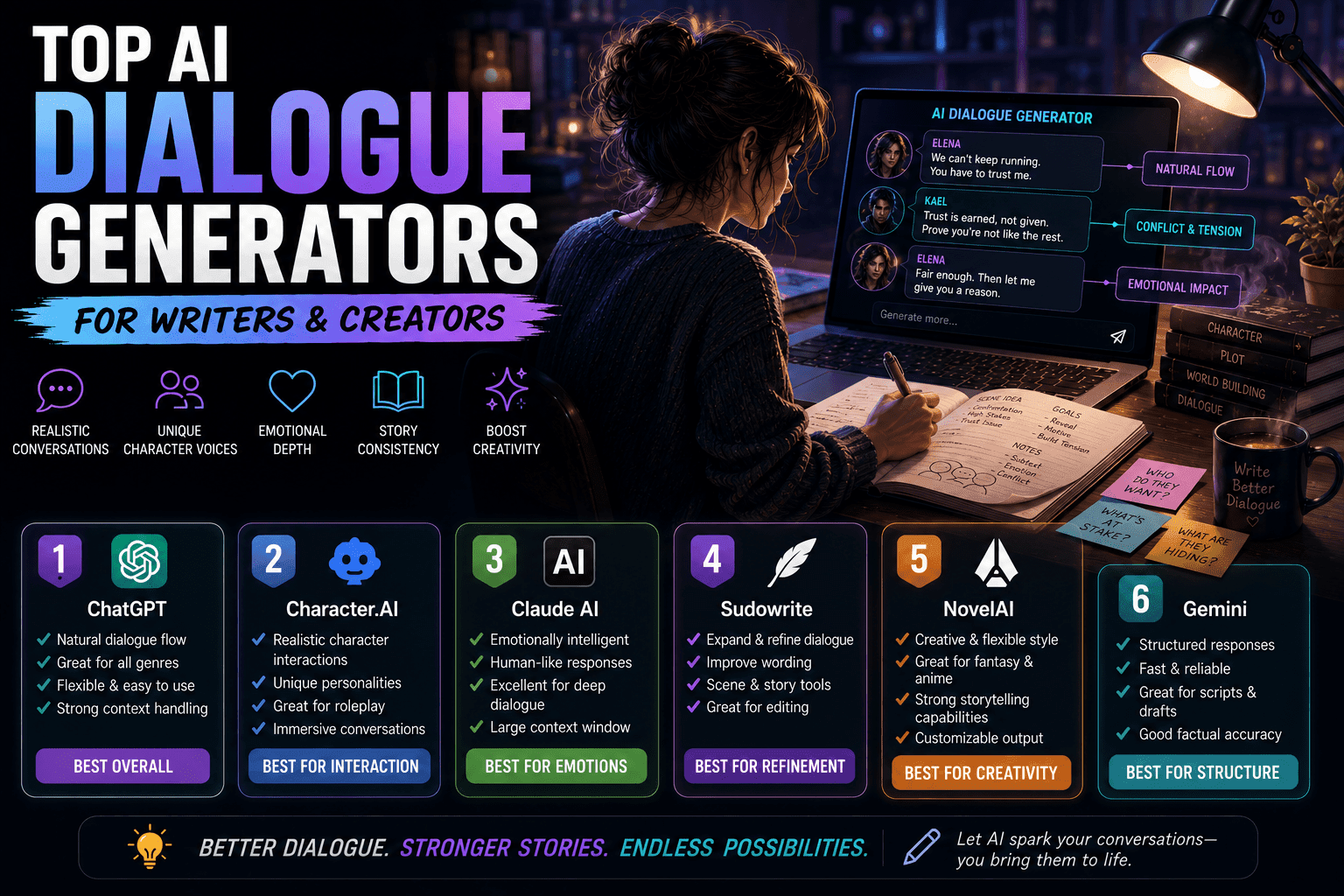
This guide ranks the top AI dialogue generators for writers and creators based on realism, creativity, consistency, and usability.
What Makes a Great AI Dialogue Generator?
Before choosing a tool, here’s what actually matters.
1. Character Voice
Can different characters sound unique?
2. Emotional Realism
Does dialogue feel human and reactive?
3. Context Memory
Can the AI remember previous scenes and interactions?
4. Conversation Flow
Do exchanges feel natural or robotic?
5. Creative Flexibility
Can you shape tone, pacing, and style?
Most tools are good at one or two of these. Very few consistently handle all five.
1. ChatGPT — Best Overall Dialogue Generator
Why It’s #1
ChatGPT remains the most balanced dialogue-writing tool available in 2026.
Strengths
- Strong conversational flow
- Flexible prompt handling
- Good emotional tone
- Works across genres
Weaknesses
- Needs structured prompts for distinct voices
- Can become repetitive in long scenes
Best For
- General dialogue writing
- Screenplays
- Story scenes
- Interactive fiction
2. Character.AI — Best for Realistic Character Interaction
Why It Stands Out
Character.AI excels at immersive character conversations and roleplay dialogue.
Strengths
- Natural conversational rhythm
- Strong personality simulation
- Great for emotional exchanges
Weaknesses
- Weak narrative structure
- Memory fades in long sessions
Best For
- Roleplay writing
- Character testing
- Dialogue realism practice
3. Claude AI — Best for Emotional Dialogue
Why It Stands Out
Claude produces smoother and more emotionally nuanced conversations.
Strengths
- Human-like prose
- Strong emotional subtlety
- Excellent long-context handling
Weaknesses
- Less dynamic conflict generation
- Can feel overly restrained
Best For
- Literary fiction
- Emotional storytelling
- Character-driven scenes
4. Sudowrite — Best for Dialogue Refinement
Why It Stands Out
Sudowrite focuses heavily on improving and rewriting scenes.
Strengths
- Dialogue expansion tools
- Scene enhancement features
- Writer-focused workflow
Weaknesses
- Less interactive than chatbot systems
- Paid-heavy features
Best For
- Revising weak dialogue
- Polishing scenes
- Fiction writing
5. NovelAI — Best for Creative & Fantasy Dialogue
Why It Stands Out
NovelAI is excellent for stylized conversations and fantasy storytelling.
Strengths
- Strong stylistic flexibility
- Great for fantasy dialogue
- Creative tone control
Weaknesses
- Learning curve
- Less structured guidance
Best For
- Fantasy writers
- Anime-inspired stories
- Experimental dialogue
6. Gemini — Best for Structured Dialogue Assistance
Why It Stands Out
Gemini works best for organized and research-heavy dialogue generation.
Strengths
- Strong contextual organization
- Fast response generation
- Good structured output
Weaknesses
- Dialogue can feel formal
- Less emotional realism
Best For
- Script drafting
- Educational dialogue
- Structured storytelling
Ranking Summary
| Rank | Tool | Best Feature |
|---|---|---|
| 1 | ChatGPT | Overall balance |
| 2 | Character.AI | Realistic interaction |
| 3 | Claude AI | Emotional depth |
| 4 | Sudowrite | Dialogue refinement |
| 5 | NovelAI | Creative flexibility |
| 6 | Gemini | Structured output |
How Writers Use AI Dialogue Generators
Professional writers often use AI dialogue tools to:
- Test character chemistry
- Explore alternate scene versions
- Improve pacing
- Break writer’s block
- Develop stronger character voices
The smartest writers don’t copy outputs directly. They refine them.
Which is reassuring. Humanity still contributes something to the process besides clicking buttons.
Common Dialogue Mistakes AI Helps Fix
1. Flat Conversations
No tension or emotion.
2. Identical Character Voices
Everyone sounds the same.
3. Over-Explaining
Characters say too much directly.
4. Poor Pacing
Scenes drag endlessly.
AI tools can quickly expose these weaknesses during revision.
Future of AI Dialogue Writing
Dialogue generation is evolving toward:
- Emotion-aware AI conversations
- Persistent character memory
- Multi-character interaction systems
- Real-time narrative adaptation
Research projects are already experimenting with AI characters capable of maintaining deeper personality continuity and emotional responsiveness during storytelling interactions.
FAQs
1. What is the best AI dialogue generator?
ChatGPT is currently the best overall for flexibility and writing quality.
2. Which AI tool creates the most realistic conversations?
Character.AI produces some of the most immersive conversational interactions.
3. Can AI improve dialogue writing?
Yes, especially for pacing, character voice, and emotional flow.
4. Which AI is best for emotional dialogue?
Claude AI performs especially well with nuanced emotional conversations.
5. Should writers rely completely on AI dialogue?
No. AI should assist creativity, not replace editing and storytelling judgment.