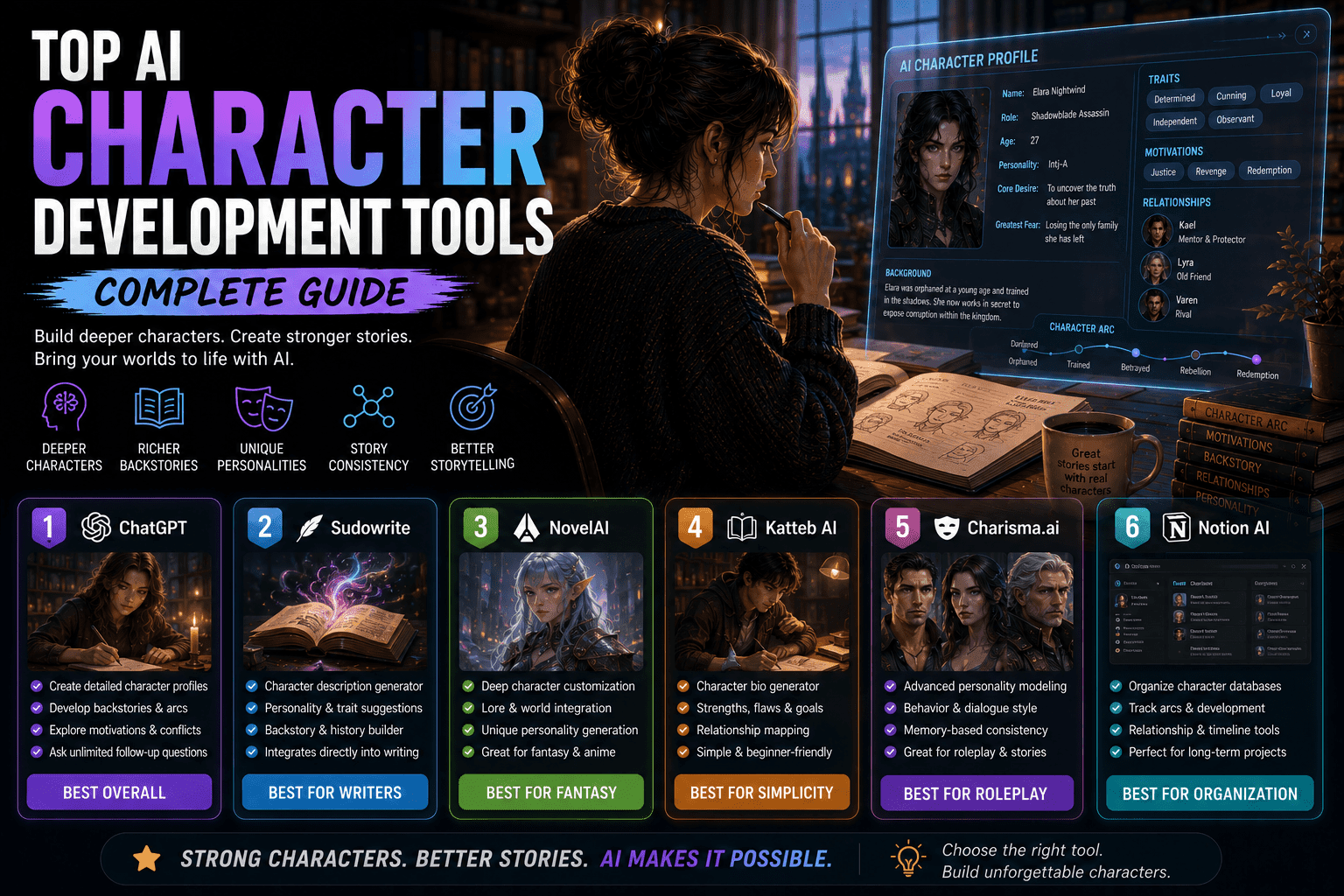

Introduction
Creating compelling characters is one of the hardest parts of storytelling. Plot can be fixed. Dialogue can be improved. But weak characters? They quietly ruin everything.
This is exactly where AI character development tools come in.
Character AI: What It Is, How It Works, and Why Millions Use It (Complete Guide)
In 2026, these tools are no longer just “idea generators.” They help writers:
- Build detailed personalities
- Generate backstories
- Test character behavior
- Simulate interactions
- Maintain consistency across stories
But here’s the catch: most tools are either creative but shallow… or structured but lifeless.
This complete guide breaks down the best AI character development tools, how they work, and how to use them effectively without turning your characters into generic templates.
What Makes a Great Character Development Tool?
Before choosing a tool, understand what actually matters.
1. Character Depth
Can it generate motivations, flaws, and internal conflict?
2. Personality Consistency
Does the character behave consistently over time?
3. Customization
Can you control traits, tone, and behavior?
4. Interaction Capability
Can you test the character through dialogue or roleplay?
5. Creativity
Does it generate unique characters or clichés?
Most tools excel in 2–3 areas. Very few handle all five well.
1. ChatGPT — Best Overall Character Development Tool
Why It’s #1
ChatGPT offers the most flexibility for building deep, customizable characters.
Strengths
- Detailed character profiles
- Strong backstory generation
- Flexible prompts
- Works across genres
Weaknesses
- Requires good prompting
- Can repeat patterns
Best For
- Full character creation
- Backstory writing
- Personality design
2. Character.AI — Best for Personality Simulation
Why It Stands Out
Character.AI allows you to interact with your characters in real time.
Strengths
- Realistic character behavior
- Strong dialogue simulation
- Immersive interaction
Weaknesses
- Weak structured output
- Limited long-term control
Best For
- Testing character voice
- Dialogue practice
- Roleplay development
3. Claude AI — Best for Deep Character Writing
Why It Stands Out
Claude excels at nuanced, emotionally rich character writing.
Strengths
- Natural writing tone
- Strong emotional depth
- Consistent character voice
Weaknesses
- Less interactive
- More restrained creativity
Best For
- Character arcs
- Emotional storytelling
- Literary writing
4. Janitor AI — Best for Custom Character Creation
Why It Stands Out
Janitor AI gives users full control over character design.
Strengths
- High customization
- Flexible personality setup
- Strong roleplay potential
Weaknesses
- Setup complexity
- Depends on user input quality
Best For
- Advanced users
- Custom characters
- Creative experimentation
5. NovelAI — Best for Creative Character Design
Why It Stands Out
NovelAI is strong for stylized and imaginative characters.
Strengths
- Unique character concepts
- Strong fantasy/anime styles
- Creative flexibility
Weaknesses
- Learning curve
- Less structured output
Best For
- Fantasy writing
- Worldbuilding
- Creative storytelling
6. Gemini — Best for Structured Character Profiles
Why It Stands Out
Gemini is great for organized character sheets and structured output.
Strengths
- Clean formatting
- Fast generation
- Good for templates
Weaknesses
- Less creative depth
- Dialogue feels weaker
Best For
- Character sheets
- Organized writing
Complete Comparison Table
| Tool | Best Feature | Best Use Case | Weakness |
|---|---|---|---|
| ChatGPT | Flexibility | Full character creation | Needs prompting |
| Character.AI | Interaction | Dialogue & roleplay | Weak structure |
| Claude AI | Depth | Emotional writing | Less dynamic |
| Janitor AI | Customization | Advanced characters | Setup complexity |
| NovelAI | Creativity | Fantasy characters | Learning curve |
| Gemini | Structure | Character sheets | Less emotion |
How to Use AI for Better Character Development
Step 1: Start with Core Traits
Define personality, goals, and flaws.
Step 2: Build Backstory
Use AI to expand past events and motivations.
Step 3: Test Through Dialogue
Interact with your character to refine voice.
Step 4: Add Conflict
Introduce internal and external struggles.
Step 5: Refine Consistency
Ensure behavior matches personality across scenes.
Common Character Development Mistakes
- Creating perfect characters (boring)
- Ignoring flaws and conflict
- Using generic traits
- Not testing dialogue
- Skipping refinement
AI helps, but it doesn’t fix lazy design.
Future of AI Character Development
Character tools are evolving toward:
- Persistent personality memory
- Emotion-aware interactions
- Multi-character simulations
- Real-time narrative systems
Soon, characters won’t just be written — they’ll be experienced.
FAQs
1. What is the best AI tool for character development?
ChatGPT is the best overall for flexibility and depth.
2. Can AI create realistic characters?
Yes, with proper prompts and refinement.
3. Which AI is best for roleplay characters?
Character.AI is best for interactive characters.
4. Do I still need to edit AI-generated characters?
Yes, refinement is essential for quality.
5. Are AI character tools good for beginners?
Yes, they simplify character creation and learning.