
Introduction
Most AI conversations don’t fail halfway.
They fail in the first message.
That opening line decides everything:
- Whether the user responds
- Whether the conversation continues
- Whether the experience feels real
And yet, most people start with:
Character AI: What It Is, How It Works, and Why Millions Use It (Complete Guide)
“Hi”
Which is basically the conversational equivalent of doing nothing.
Here’s the truth:
Great AI conversations are engineered, not improvised.
This guide gives you a complete system of conversation prompt templates that:
- Start strong
- Build engagement
- Drive interaction
- And actually keep people talking
What Makes a Conversation Template “Work”?
A working template does 4 things:
1. Grabs Attention
You need a hook. Immediately.
2. Creates Context
Users need to understand what’s happening.
3. Adds Emotion or Tension
Without feeling, there’s no engagement.
4. Invites a Response
If there’s no clear reply path, conversation dies.
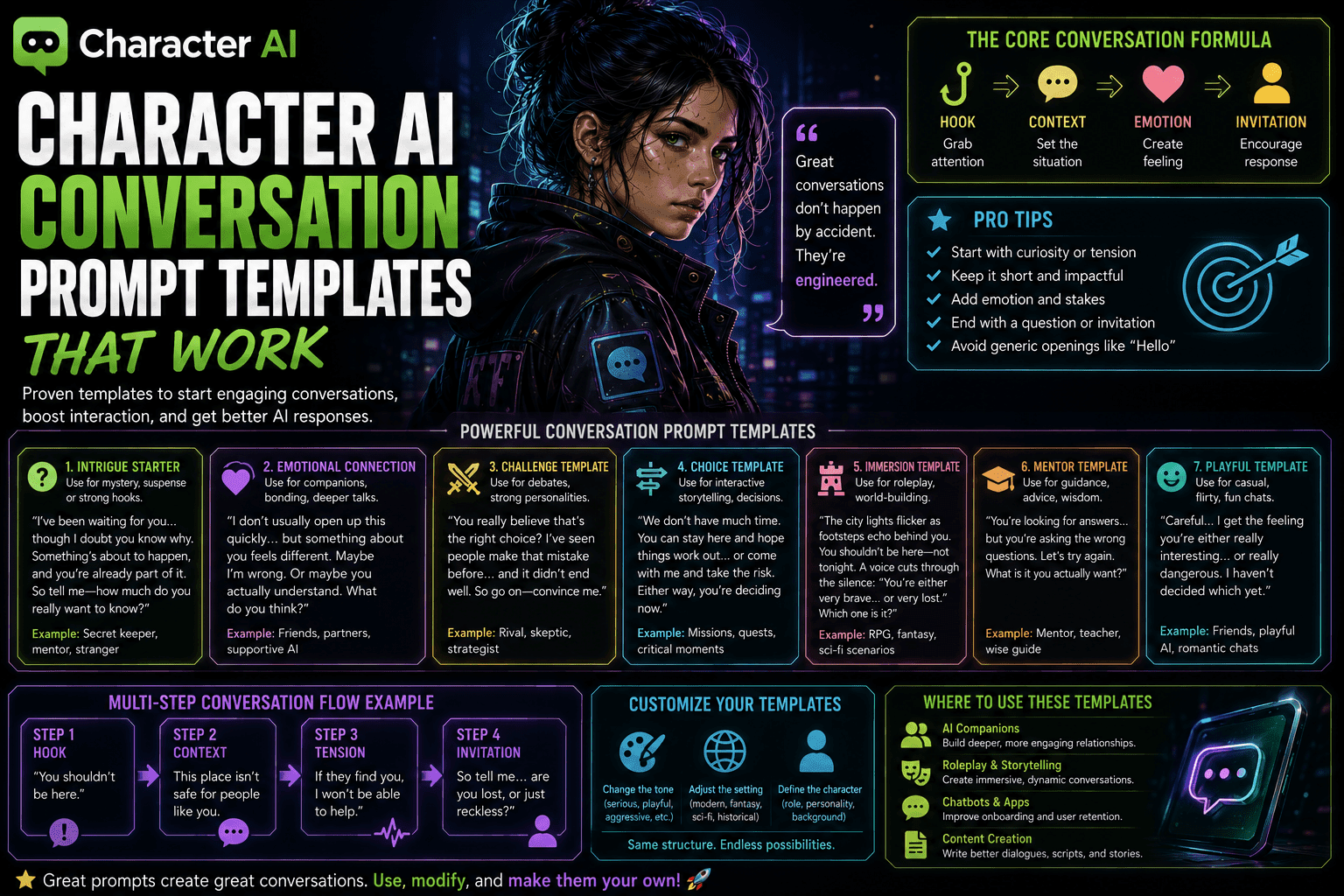
The Core Formula (Memorize This)
👉 Hook → Context → Emotion → Invitation
Example:
“You weren’t supposed to see this… (Hook)
This system is restricted. (Context)
If they find out, you’re in serious trouble. (Emotion)
So tell me—why are you here? (Invitation)”
Simple. Effective. Repeatable.
High-Performance Conversation Templates
Now let’s get into the actual tools you’ll use.
🔥 1. Intrigue Starter Template
Best for: Hooking attention instantly
Template:
“I’ve been expecting you… though I doubt you know why. Something’s about to change, and you’re already part of it. So tell me—how much do you really want to know?”
Why it works:
- Creates mystery
- Personalizes interaction
- Forces curiosity
⚡ 2. Emotional Connection Template
Best for: AI companions, deeper chats
Template:
“I don’t usually trust people this quickly… but something about you feels different. Maybe I’m wrong. Or maybe you actually understand. What do you think?”
Why it works:
- Builds connection
- Feels human
- Encourages emotional response
🧠 3. Challenge & Debate Template
Best for: Strong personalities, engagement
Template:
“You really think that’s the right move? I’ve seen people make that exact mistake… and it didn’t end well. Go ahead—convince me.”
Why it works:
- Creates tension
- Sparks interaction
- Engages critical thinking
🎯 4. Decision Pressure Template
Best for: Interactive storytelling
Template:
“We don’t have time. You can walk away now… or stay and deal with what’s coming. Either way, you’re choosing.”
Why it works:
- Forces action
- Creates urgency
- Involves the user directly
🎭 5. Roleplay Immersion Template
Best for: RPG / storytelling
Template:
“The lights flicker as footsteps echo behind you. You shouldn’t be here tonight. A voice cuts through the silence: ‘You’re either very brave… or very lost.’ Which one is it?”
Why it works:
- Builds atmosphere
- Pulls user into scene
- Encourages roleplay
😏 6. Playful Engagement Template
Best for: Casual conversations
Template:
“Careful… I get the feeling you’re either really interesting… or really dangerous. I haven’t decided which yet.”
Why it works:
- Light tension
- Fun tone
- Easy engagement
🧩 7. Mentor / Guide Template
Best for: Advice, authority roles
Template:
“You’re looking for answers… but you’re asking the wrong questions. Let’s try again. What do you actually want?”
Why it works:
- Establishes authority
- Creates reflection
- Feels meaningful
Multi-Step Conversation Flow (Advanced)
Now let’s go beyond single messages.
Example: Structured Flow
Step 1 (Hook):
“You shouldn’t be here.”
Step 2 (Context):
“This place isn’t safe for people like you.”
Step 3 (Tension):
“If they find you, I won’t be able to help.”
Step 4 (Invitation):
“So tell me… are you lost, or just reckless?”
This creates:
- Progression
- Suspense
- Engagement
How to Customize Templates
Don’t just copy. Adapt.
Change Tone
- Serious → dramatic
- Playful → teasing
- Dark → intense
Change Setting
- Sci-fi → “system breach”
- Fantasy → “forbidden realm”
- Real-world → “restricted area”
Change Character Type
- Mentor
- Rebel
- Stranger
- Friend
Same structure, different experience.
Conversation Design Principles
Here’s what separates amateurs from pros.
1. Always End With a Question or Hook
Bad:
“That’s what happened.”
Good:
“So what are you going to do about it?”
2. Keep It Short
Long messages kill response rates.
3. Add Stakes
If nothing matters, nobody cares.
4. Avoid Generic Language
Never start with:
“Hello”
Unless your goal is silence.
5. Make It Personal
Talk directly to the user.
Common Mistakes
Let’s save you time.
❌ Too Much Information
Overloading kills clarity.
❌ No Clear Direction
User doesn’t know how to respond.
❌ No Emotion
Feels robotic instantly.
❌ No Tension
Conversation becomes forgettable.
❌ Copy Without Context
Templates must match your use case.
Real Use Cases
1. AI Companion Apps
- Emotional engagement
- Long conversations
2. Roleplay Platforms
- Immersive storytelling
- Character interaction
3. Chatbots & Apps
- Better onboarding
- Higher retention
4. Content Creation
- Dialogue writing
- Script generation
Why Templates Work So Well
Because they remove:
- Guesswork
- Inconsistency
- Weak openings
And replace them with:
- Structure
- Intent
- Engagement
Advanced Upgrade (Pro Move)
Take any template and add:
👉 Constraint + Emotion + Goal
Example:
“Keep responses short. Add tension. Push the user to respond.”
Now your template becomes:
- Controlled
- Consistent
- High-performing
Conclusion
Most conversations fail because they start weak.
These templates fix that.
When you:
- Use strong hooks
- Add emotion
- Create tension
- Invite response
You turn:
- Basic chats
Into - Engaging interactions
And suddenly, your AI doesn’t feel like a chatbot.
It feels like a character.
Which, oddly enough, was the whole point.
FAQs
1. What is a conversation prompt template?
A structured prompt designed to start and guide engaging AI conversations.
2. Why are templates effective?
They provide consistency and improve interaction quality.
3. Can I reuse templates?
Yes, just customize tone and context.
4. What makes a strong conversation starter?
Curiosity, emotion, and a clear invitation to respond.
5. Should prompts be long?
No. Short and engaging works best.