
Quick Summary
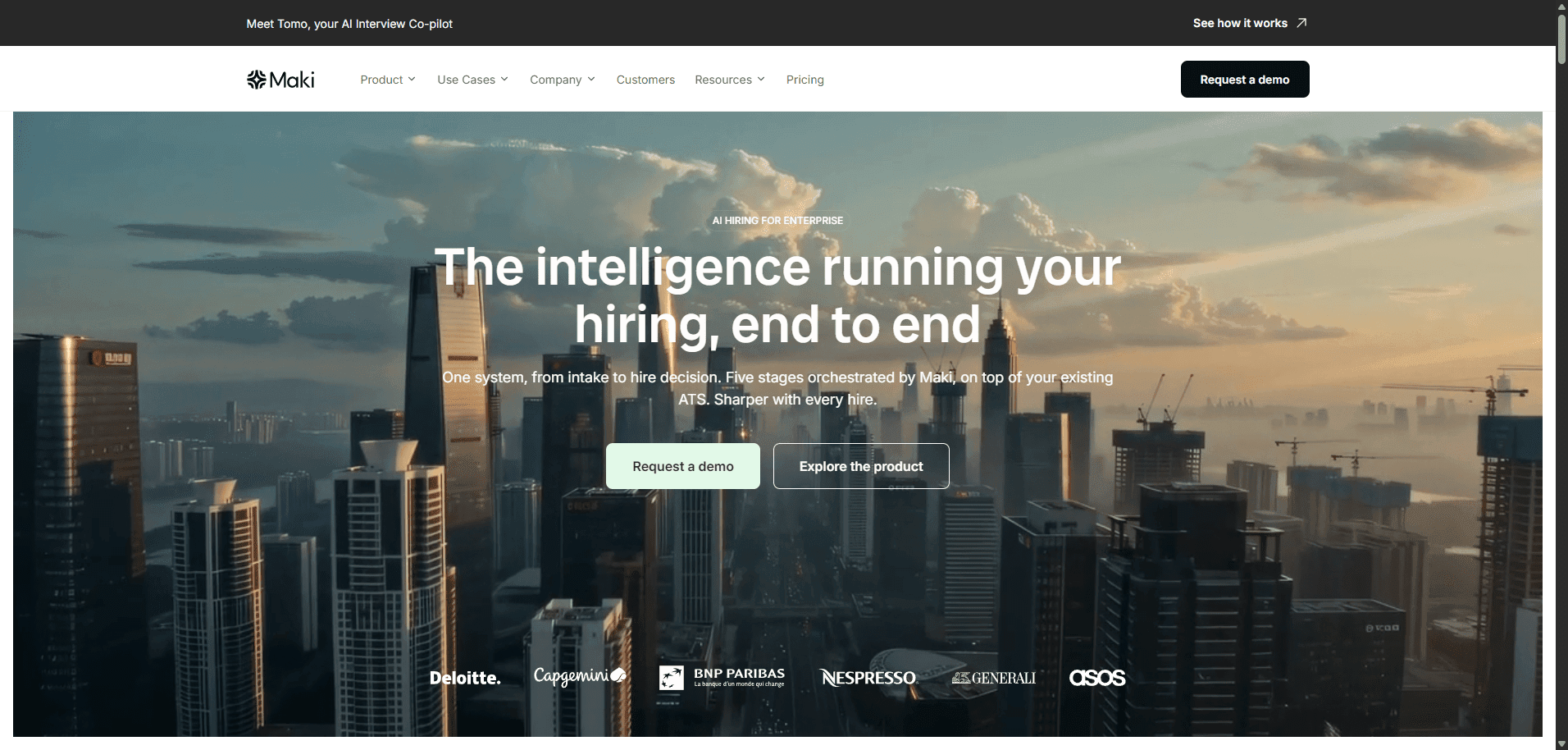
Maki People is built for one thing: faster, smarter hiring decisions using AI-powered candidate evaluation. It goes beyond resume screening by assessing real skills through automated testing and predictive insights.
It’s best suited for HR teams, recruiters, and scaling startups that need to filter large candidate pools efficiently.
The biggest advantage is its skill-based hiring approach, but it may feel rigid for companies with highly customized hiring workflows.
Verdict: A strong AI hiring platform for structured recruitment, especially in tech and high-volume roles.
Maki People Overview
Maki People is an AI-driven recruitment platform focused on candidate screening, skill assessment, and predictive hiring analytics.
Unlike traditional ATS tools, Maki emphasizes:
- Automated skill testing
- Bias-reduced screening
- Data-backed hiring decisions
Rating Snapshot (AI Recruitment Tool)
| Category | Score |
|---|---|
| Candidate Evaluation Accuracy | ⭐⭐⭐⭐☆ (4.5/5) |
| Automation & Efficiency | ⭐⭐⭐⭐⭐ (4.6/5) |
| Ease of Use | ⭐⭐⭐⭐☆ (4.2/5) |
| Integration Capabilities | ⭐⭐⭐⭐☆ (4.1/5) |
| Value for Money | ⭐⭐⭐⭐☆ (4.3/5) |
Overall Rating: ⭐⭐⭐⭐☆ (4.3/5)
Editorial Note: Maki stands out in structured hiring environments but is less flexible for unconventional recruiting workflows.
What Makes Maki People Different?
1. Skill-Based Hiring Over Resume Screening
Maki shifts focus from CVs to real-world abilities, using:
- Pre-built assessments
- Custom skill tests
- Behavioral evaluation models
This helps reduce reliance on traditional (and often biased) resume filtering.
2. Automated Candidate Evaluation
The platform automates:
- Candidate scoring
- Ranking and filtering
- Shortlisting workflows
This is especially useful for:
- High-volume hiring
- Early-stage screening
- Remote recruitment pipelines
3. Predictive Hiring Insights
Maki uses AI models to estimate:
- Candidate performance potential
- Skill-job fit
- Hiring success probability
This adds a layer of decision intelligence, not just automation.
Real-World Use Cases
Best Fits
- Tech companies hiring developers at scale
- HR teams managing large applicant pools
- Startups needing fast hiring pipelines
- Remote-first companies
Not Ideal For
- Small teams hiring occasionally
- Creative roles requiring portfolio-first evaluation
- Companies with highly manual or relationship-driven hiring
Pricing Snapshot
| Plan | Best For | What You Get |
|---|---|---|
| Starter | Small teams | Basic assessments, limited automation |
| Growth | Scaling companies | Advanced screening, analytics |
| Enterprise | Large orgs | Custom workflows, integrations, support |
Pricing Insight: Maki follows a B2B SaaS pricing model, typically customized based on hiring volume and feature needs.
Disclaimer: Pricing may change over time. Check the official website for the latest details.
Pros and Cons
Pros
- Strong skill-based evaluation system
- Reduces hiring bias
- Saves time in early-stage screening
- Scales well for high-volume recruitment
Cons
- Less flexible for creative hiring workflows
- May require setup for custom roles
- Not ideal for low-frequency hiring
Maki People vs Traditional Hiring Tools
| Feature | Maki People | Traditional ATS |
|---|---|---|
| Screening Method | Skill-based | Resume-based |
| Automation | High | Moderate |
| Bias Reduction | Strong | Limited |
| Decision Insights | Predictive | Minimal |
Key Takeaways
Maki People is part of a growing category of AI-first hiring platforms that prioritize:
- Skills over credentials
- Data over intuition
- Automation over manual screening
That shift is particularly valuable in competitive hiring markets.
FAQs
1. What is Maki People used for?
Maki People is used for AI-powered recruitment, including candidate screening, skill assessment, and automated hiring workflows.
2. How does Maki People evaluate candidates?
It uses skill-based tests, behavioral analysis, and AI scoring models to rank candidates based on job fit.
3. Is Maki People better than traditional ATS tools?
For structured and high-volume hiring, yes. However, traditional ATS tools may be more flexible for manual hiring processes.
4. Can Maki People reduce hiring bias?
Yes, by focusing on skills and standardized assessments, it helps reduce bias in early-stage screening.
5. Is Maki People suitable for small businesses?
It can be used by small teams, but it’s more valuable for companies hiring at scale.