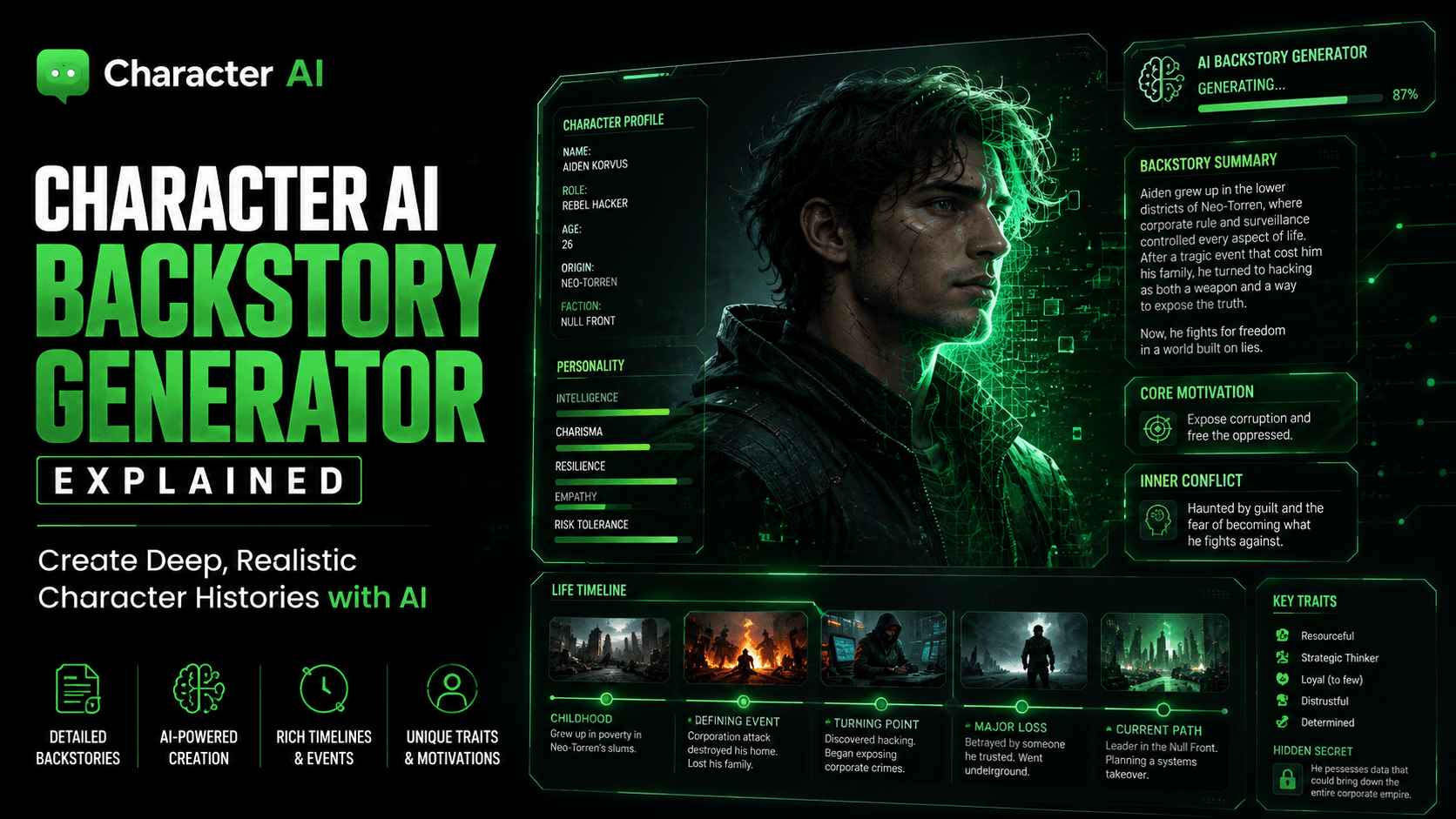

Introduction
Every memorable character has a past. The problem? Writing compelling backstories is slow, mentally exhausting, and occasionally makes you question why your fictional people have more depth than real ones.
Enter Character AI backstory generators.
Character AI: What It Is, How It Works, and Why Millions Use It (Complete Guide)
AI Character Backstory Generator (Free & Unlimited)
These tools don’t just spit out random biographies. When used correctly, they can generate layered, believable histories that shape personality, motivations, and behavior in your stories, games, or roleplay worlds.
This guide breaks down how Character AI backstory generators work, why they matter, and how to use them without ending up with generic nonsense.
What Is a Character AI Backstory Generator?
A Character AI backstory generator is an AI-powered system designed to create detailed histories for fictional characters based on prompts and parameters.
Instead of manually writing:
- Childhood experiences
- Key life events
- Relationships
- Internal conflicts
You guide the AI, and it builds a structured narrative.
Think of it as:
“Give me a character,”
but upgraded to
“Give me a life that explains why this character exists.”
Why Backstories Matter More Than You Think
A character without a backstory is just a moving prop.
Backstories influence:
- Decisions
- Dialogue
- Emotional reactions
- Moral boundaries
For example:
- A soldier who lost their squad behaves differently than one who never saw combat
- An AI raised by humans thinks differently than one trained purely on data
Backstory = behavior logic.
Without it, characters feel random. And randomness is not personality, no matter how often people pretend it is.
How Character AI Generates Backstories
Let’s demystify the “magic.”
1. Prompt Interpretation
The AI reads your input:
- Role (e.g., hacker, explorer, android)
- Setting (cyberpunk, fantasy, space)
- Tone (dark, hopeful, tragic)
The more specific you are, the less garbage you get back.
2. Pattern Recognition
AI models are trained on storytelling structures, so they:
- Recognize archetypes
- Build logical timelines
- Insert common narrative elements
That’s why you often see:
- “Lost family”
- “Hidden talent”
- “Mysterious past”
Yes, clichés are alive and thriving.
3. Narrative Assembly
The AI constructs:
- Early life
- Major turning points
- Current situation
If your prompt is good, this becomes layered.
If your prompt is lazy, you get something that reads like it was written during a coffee shortage.
Key Elements of a Strong AI-Generated Backstory
Not all backstories are worth keeping. Shocking.
Here’s what separates usable from forgettable:
1. Clear Origin
Where the character comes from:
- Location
- Culture
- Environment
This shapes worldview.
2. Defining Events
Moments that changed them:
- Loss
- Discovery
- Betrayal
- Achievement
No defining event = no reason for growth.
3. Internal Conflict
What they struggle with:
- Guilt
- Identity
- Fear
- Ambition
Conflict creates depth. Without it, you get a walking résumé.
4. Motivation
Why they act:
- Revenge
- Survival
- Curiosity
- Redemption
Motivation drives story progression.
5. Flaws and Contradictions
Perfect characters are unbearable.
Give them:
- Biases
- Weaknesses
- Emotional blind spots
Even AI-generated ones need to feel imperfect.
Types of Backstories You Can Generate
Because apparently one flavor of trauma isn’t enough.
1. Heroic Backstories
- Rising from adversity
- Strong moral compass
- Driven by purpose
2. Tragic Backstories
- Loss and suffering
- Emotional damage
- Dark motivations
3. Anti-Hero Backstories
- Morally gray
- Conflicting values
- Personal code over rules
4. Mysterious Backstories
- Missing memories
- Hidden past
- Unreliable identity
5. Sci-Fi Backstories
- AI awakening
- Space colonization
- Genetic modification
Each type shapes tone and storytelling direction.
How to Use Character AI for Backstory Generation
Let’s avoid the classic mistake of expecting brilliance from vague input.
Step 1: Define Core Details
Start with:
- Role
- Setting
- Personality
Example:
“A cyberpunk data thief with trust issues in a corporate-controlled city”
Already better than “make a cool character.”
Step 2: Add Constraints
Tell the AI what to include:
- A major betrayal
- A moral dilemma
- A hidden secret
Constraints force creativity.
Step 3: Generate Multiple Variations
Never trust the first output.
Generate:
- 2–5 versions
- Mix and match elements
Yes, you’re editing the AI. Welcome to collaboration.
Step 4: Refine and Expand
Take the best version and:
- Deepen emotional layers
- Add specificity
- Remove clichés
AI gives you a draft, not a masterpiece.
Example Prompt (That Actually Works)
Bad prompt:
“Write a character backstory”
Congratulations, you’ll get something painfully generic.
Good prompt:
“Create a detailed backstory for a female android detective in a dystopian city. She was originally designed for military use but now solves crimes. Include a past failure that still haunts her and affects her decision-making.”
Now the AI has direction, tension, and stakes.
Common Mistakes to Avoid
1. Being Too Vague
You’ll get bland output. Every time.
2. Accepting First Results
AI is a draft generator, not a mind reader.
3. Ignoring Consistency
Make sure the backstory fits your world rules.
4. Overloading the Character
Too many dramatic events = unrealistic chaos.
One or two strong arcs > ten random tragedies.
5. No Emotional Depth
If the backstory doesn’t affect behavior, it’s useless.
Advanced Techniques
1. Layered Prompting
Generate:
- Basic backstory
- Then expand childhood
- Then expand trauma
Build depth step by step.
2. Perspective-Based Backstories
Ask the AI to rewrite the same backstory from:
- The character’s view
- An enemy’s view
- A neutral observer
Now you have complexity.
3. Integrating with Character AI Chats
Once the backstory is created:
- Feed it into your Character AI
- Let the character respond in real time
Now the backstory actually influences behavior.
Which, surprisingly, is the whole point.
Benefits of Using Character AI for Backstories
- Saves time
- Sparks creativity
- Helps overcome writer’s block
- Generates unexpected ideas
Also:
- Forces you to think in systems, not just scenes
Which is annoyingly useful.
Limitations You Shouldn’t Ignore
Because yes, there are flaws.
- Repetitive tropes
- Occasional logical gaps
- Lack of deep originality without guidance
AI is powerful, but it’s not magically insightful. You still have to think.
Unfortunate, I know.
The Future of AI-Generated Character Design
We’re moving toward:
- Fully interactive character histories
- Real-time evolving backstories
- AI characters that remember and adapt
Soon, backstories won’t just be written.
They’ll be experienced.
Which is either exciting or slightly unsettling depending on how attached you get to fictional people.
Conclusion
Character AI backstory generators are tools, not replacements for creativity.
Used well, they:
- Accelerate your workflow
- Add depth to characters
- Unlock new storytelling paths
Used poorly, they:
- Produce generic, forgettable noise
So the real skill isn’t “using AI.”
It’s knowing how to guide it.
Which means, unfortunately, you still have to be good at storytelling.
Tragic. 😌
FAQs
1. What is a Character AI backstory generator?
It’s an AI tool that creates detailed character histories based on prompts, helping writers build realistic and engaging characters quickly.
2. Can AI-generated backstories replace human writing?
No. They assist and speed up the process, but human creativity is still needed for depth, refinement, and originality.
3. Are AI backstories unique?
They can be, but without strong prompts, they often rely on common storytelling tropes.
4. How do I improve AI-generated backstories?
Use detailed prompts, generate multiple versions, and refine the output by adding emotional depth and specificity.
5. Can I use these backstories for games or roleplay?
Yes. They are widely used in RPGs, storytelling, and character-driven simulations.