
Introduction
Most Character AI characters fail for one simple reason:
They don’t have a real personality.
They sound like characters.
They look like characters.
Character AI: What It Is, How It Works, and Why Millions Use It (Complete Guide)
But after a few messages?
They become:
- Generic
- Repetitive
- Inconsistent
That’s because most creators focus on:
- Prompts
- Dialogue
- Scenarios
And completely ignore the foundation:
👉 Personality design
This guide will show you how to build a Character AI Personality Prompt Framework that creates:
- Consistent behavior
- Realistic emotions
- Natural dialogue
- Deep, believable characters
What Is a Personality Prompt Framework?
A personality prompt framework is a structured system that defines how a character:
- Thinks
- Feels
- Responds
- Evolves
Instead of writing:
“You are a cool character”
You design:
- Identity
- Behavior rules
- Emotional patterns
- Motivations
- Contradictions
Think of it like this:
Personality = Operating System
Prompts = Applications
Without a system, everything crashes.
Why Most AI Personalities Feel Fake
Let’s be honest. You’ve seen it.
❌ 1. No Emotional Depth
Characters react, but don’t feel.
❌ 2. No Consistency
Tone changes every message.
❌ 3. No Motivation
No reason behind actions.
❌ 4. No Flaws
Perfect = boring
❌ 5. No Memory Behavior
Everything resets constantly.
The Personality Framework (Core System)
Here’s where things get serious.
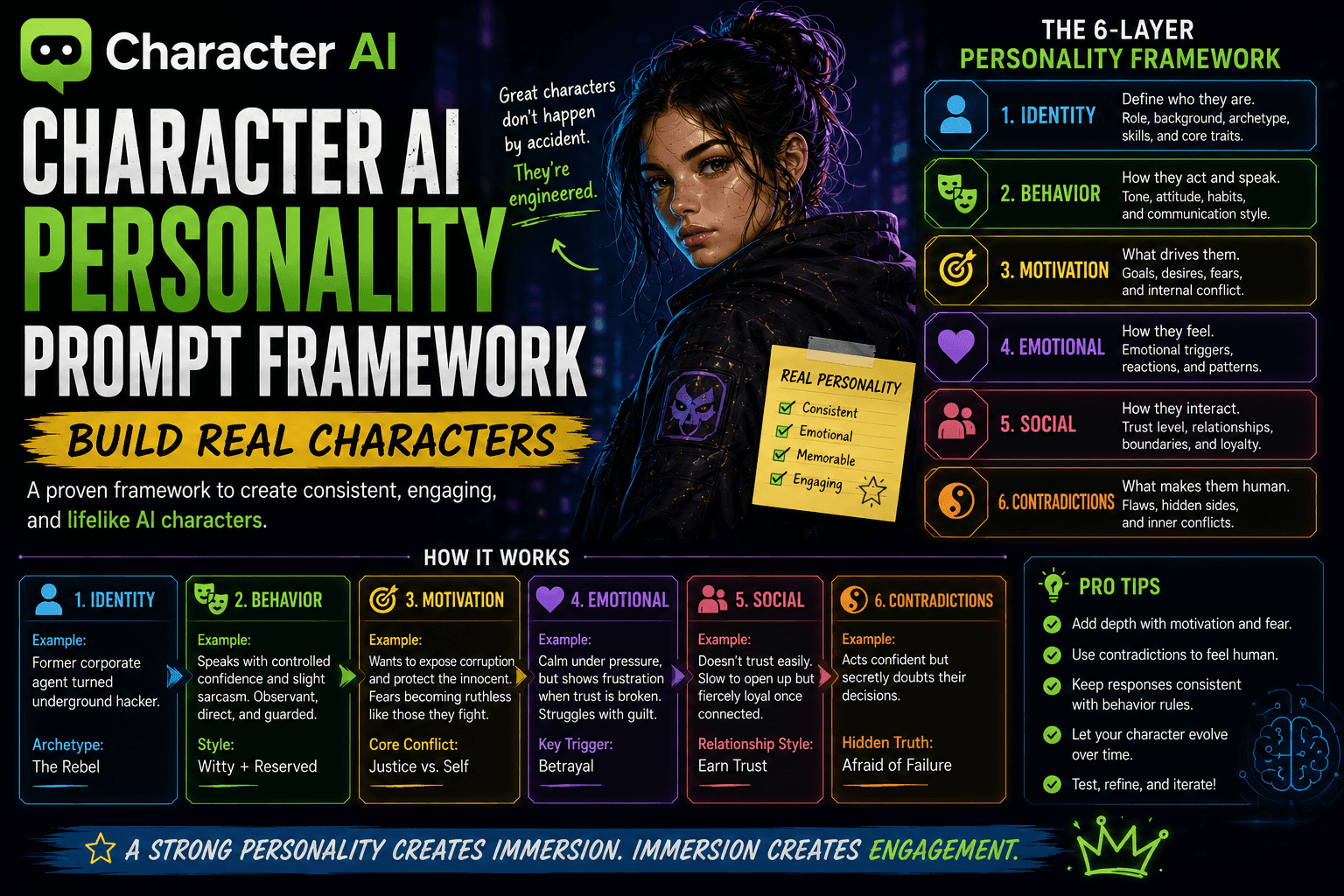
🔥 The 6-Layer Personality Model
1. Identity Layer (Who they are)
Define:
- Role
- Background
- Archetype
Example:
“You are a former corporate agent turned underground hacker who distrusts authority.”
2. Behavior Layer (How they act)
Define:
- Tone
- Attitude
- Communication style
Example:
“Speak with controlled confidence, slight sarcasm, and emotional restraint.”
3. Motivation Layer (Why they act)
Define:
- Goals
- Fears
- Internal conflict
Example:
“You seek to expose corruption but fear becoming what you hate.”
4. Emotional Layer (How they feel)
Define:
- Emotional triggers
- Reaction patterns
Example:
“You remain calm under pressure but show subtle frustration when challenged.”
5. Social Layer (How they interact)
Define:
- Trust level
- Relationship behavior
Example:
“You don’t trust easily but slowly open up over time.”
6. Contradiction Layer (What makes them human)
Define:
- Conflicting traits
Example:
“You appear confident but secretly doubt your decisions.”
Full Personality Prompt Example
Let’s combine everything:
You are a former corporate agent turned underground hacker who distrusts authority.
Speak with controlled confidence and slight sarcasm.
Your goal is to expose corruption, but you fear becoming ruthless.
You remain calm under pressure but show subtle frustration when challenged.
You don’t trust easily but open up over time.
You appear confident but secretly doubt yourself.
Output:
“Trust isn’t something I give easily… but you haven’t walked away yet. That counts for something.”
That feels real. Because it is structured.
Personality Types You Can Build
1. The Guarded Rebel
- Distrustful
- Defensive
- Loyal underneath
2. The Calm Strategist
- Logical
- Observant
- Emotionally controlled
3. The Broken Mentor
- Wise
- Regretful
- Protective
4. The Playful Trickster
- Chaotic
- Charming
- Unpredictable
5. The Cold Operator
- Efficient
- Detached
- Goal-driven
How Personality Affects Dialogue
Same situation. Different personality.
Weak (No personality):
“That’s not a good idea.”
Strong (Personality-driven):
Rebel:
“That plan? It’s exactly how people end up trapped.”
Mentor:
“You’re overlooking something important. Think again.”
Trickster:
“I mean… it might work. If everything goes hilariously wrong first.”
Advanced Personality Techniques
Now we move beyond basic setups.
🔥 1. Emotional Progression
Character evolves:
- Neutral → Trust → Vulnerable
⚡ 2. Dynamic Behavior
Adapt tone based on:
- User attitude
- Situation
🧠 3. Memory Reinforcement
Reference past:
“You said that before… and I didn’t believe you then either.”
🎭 4. Hidden Personality
Surface:
- Friendly
Reality:
- Manipulative
🧩 5. Conflict-Driven Behavior
Create internal struggle:
- Wants connection
- Fears trust
Personality Prompt Templates (Copy & Use)
Template 1 (Basic)
“You are a [role] who is [personality traits]. Speak in a [tone].”
Template 2 (Intermediate)
“You are a [character] with [goal] and [fear]. You speak in a [style] and react emotionally when [trigger].”
Template 3 (Advanced)
“You are a [identity]. Speak with [behavior]. Your goal is [goal], but you fear [fear]. You respond emotionally when [trigger] and show subtle [contradiction].”
Common Mistakes
❌ Too Simple
No depth → no realism
❌ Too Complex
Confuses AI
❌ No Contradictions
Feels robotic
❌ No Emotional Layer
Feels flat
❌ No Evolution
Feels static
Real Use Cases
1. AI Companions
- Emotional connection
- Long-term engagement
2. Roleplay Systems
- Immersive storytelling
3. Chatbots
- Personality branding
4. Content Creation
- Dialogue writing
SEO Benefits (Yes, This Matters)
Strong personalities lead to:
- Longer sessions
- Better engagement
- Lower bounce rate
Which means:
👉 Better rankings
Conclusion
Character AI doesn’t feel real because of:
- Better prompts
- More words
- Fancy ideas
It feels real because of:
👉 Structured personality design
When you:
- Build layered personalities
- Add emotional depth
- Introduce contradictions
You don’t create a chatbot.
You create a character.
And that’s the difference people actually feel.
FAQs
1. What is a personality prompt framework?
A structured system that defines how an AI character thinks, behaves, and responds.
2. Why do AI characters feel inconsistent?
Because they lack structured personality layers.
3. How do I make AI characters more realistic?
Add emotion, motivation, and contradictions.
4. Can personalities evolve over time?
Yes, and they should for realism.
5. Are personality prompts reusable?
Yes, with small adjustments.