
Introduction
Dialogue is where most writing either comes alive… or completely collapses.
You can have a great plot, interesting characters, even a strong concept — but if your dialogue feels stiff, robotic, or repetitive, the entire story suffers.
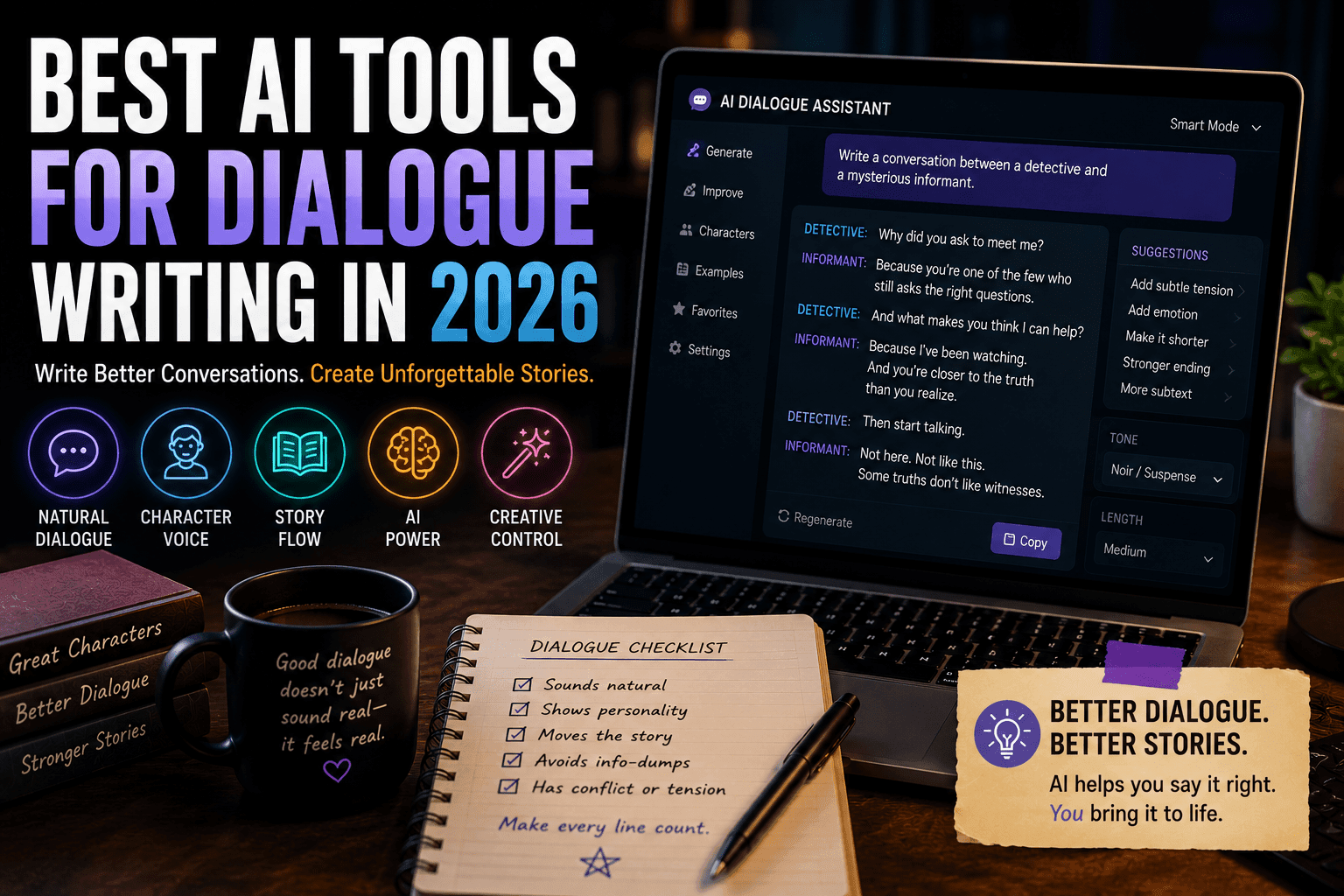
That’s why AI tools for dialogue writing have become incredibly popular in 2026. Not because they replace writers, but because they help you:
- Generate realistic conversations
- Test character voices
- Improve pacing and flow
- Add emotional depth
But not all AI tools are good at dialogue. Some sound like formal emails. Others are chaotic but entertaining. A few actually get it right.
Character AI: What It Is, How It Works, and Why Millions Use It (Complete Guide)
This guide breaks down the best AI tools for dialogue writing in 2026 and how to use them effectively.
What Makes a Good Dialogue AI Tool
Before choosing a tool, you need to know what matters.
1. Character Voice Control
Each character should sound unique.
2. Emotional Depth
Dialogue should reflect mood and tension.
3. Natural Flow
Conversations should feel human, not scripted.
4. Context Awareness
The AI should remember what was said before.
5. Customization
You should be able to guide tone and behavior.
Most tools fail at at least one of these.
1. ChatGPT — Best Overall Dialogue Tool
Strengths
- Strong conversational ability
- Flexible prompt control
- Good at tone shifting
- Works across genres
Weaknesses
- Needs guidance for distinct voices
- Can repeat patterns
Best For
- Dialogue writing + editing
- Scene conversations
- All-purpose writing
2. Character.AI — Best for Realistic Conversations
Strengths
- Highly immersive dialogue
- Strong personality simulation
- Great for roleplay
Weaknesses
- Weak structure control
- Conversations can drift
Best For
- Dialogue practice
- Character interaction
- Realistic conversational flow
3. Claude AI — Best for Natural Dialogue Tone
Strengths
- Smooth, human-like responses
- Strong emotional nuance
- Better long-form consistency
Weaknesses
- Less aggressive or dynamic tone
- Can feel too safe
Best For
- Emotional dialogue
- Character-driven scenes
- Literary writing
4. Sudowrite — Best for Dialogue Refinement
Strengths
- Dialogue rewriting tools
- Scene expansion
- Writer-focused features
Weaknesses
- Requires paid plan
- Less interactive than chatbots
Best For
- Editing dialogue
- Improving weak conversations
- Structured writing
5. NovelAI — Best for Creative Dialogue Styles
Strengths
- High stylistic flexibility
- Strong for fantasy/anime tone
- Customizable outputs
Weaknesses
- Learning curve
- Less beginner-friendly
Best For
- Stylized dialogue
- Fantasy storytelling
- Experimental writing
6. Gemini — Best for Structured Dialogue Support
Strengths
- Strong context handling
- Good for structured writing
- Fast responses
Weaknesses
- Less emotional depth
- Dialogue can feel formal
Best For
- Informational dialogue
- Script planning
- Structured scenes
Comparison Table
| Tool | Best Strength | Best Use | Weakness |
|---|---|---|---|
| ChatGPT | Versatility | All-purpose dialogue | Repetition |
| Character.AI | Realism | Roleplay dialogue | Weak structure |
| Claude | Natural tone | Emotional dialogue | Less dynamic |
| Sudowrite | Editing | Dialogue refinement | Paid features |
| NovelAI | Style | Creative dialogue | Learning curve |
| Gemini | Structure | Info-based dialogue | Less emotion |
How to Choose the Right Tool
Use ChatGPT If:
You want a balanced tool for writing and improving dialogue.
Use Character.AI If:
You want realistic, interactive conversations.
Use Claude If:
You want natural, emotionally rich dialogue.
Use Sudowrite If:
You want to refine and polish dialogue.
Use NovelAI If:
You want stylized or creative dialogue.
Use Gemini If:
You need structured or research-based dialogue.
Common Dialogue Mistakes AI Helps Fix
- Overly formal conversations
- Repetitive phrasing
- Lack of conflict
- Identical character voices
- Weak emotional impact
Used correctly, AI can help eliminate these quickly.
FAQs
1. What is the best AI tool for dialogue writing?
ChatGPT is the best overall, but Character.AI excels at realistic conversations.
2. Can AI write realistic dialogue?
Yes, if you provide strong prompts with personality and emotional context.
3. Which AI is best for character conversations?
Character.AI is the best for immersive dialogue and roleplay.
4. Is AI dialogue good for beginners?
Yes, it helps understand flow, tone, and character voice quickly.
5. Should I rely fully on AI for dialogue?
No, AI should assist, but editing and refinement are still necessary.