
Introduction
Most AI-generated dialogue suffers from the same issues: it’s too clean, too predictable, and way too polite. Characters respond like they’re trying to pass a customer service training program instead of acting like actual humans with opinions, emotions, and bad decisions.
The problem isn’t the AI. It’s how you’re using it.
Character AI can produce sharp, engaging, realistic dialogue — but only if you apply the right techniques. This guide breaks down practical, proven dialogue improvement tricks that actually work, so your conversations stop sounding artificial and start feeling alive.
Character AI: What It Is, How It Works, and Why Millions Use It (Complete Guide)
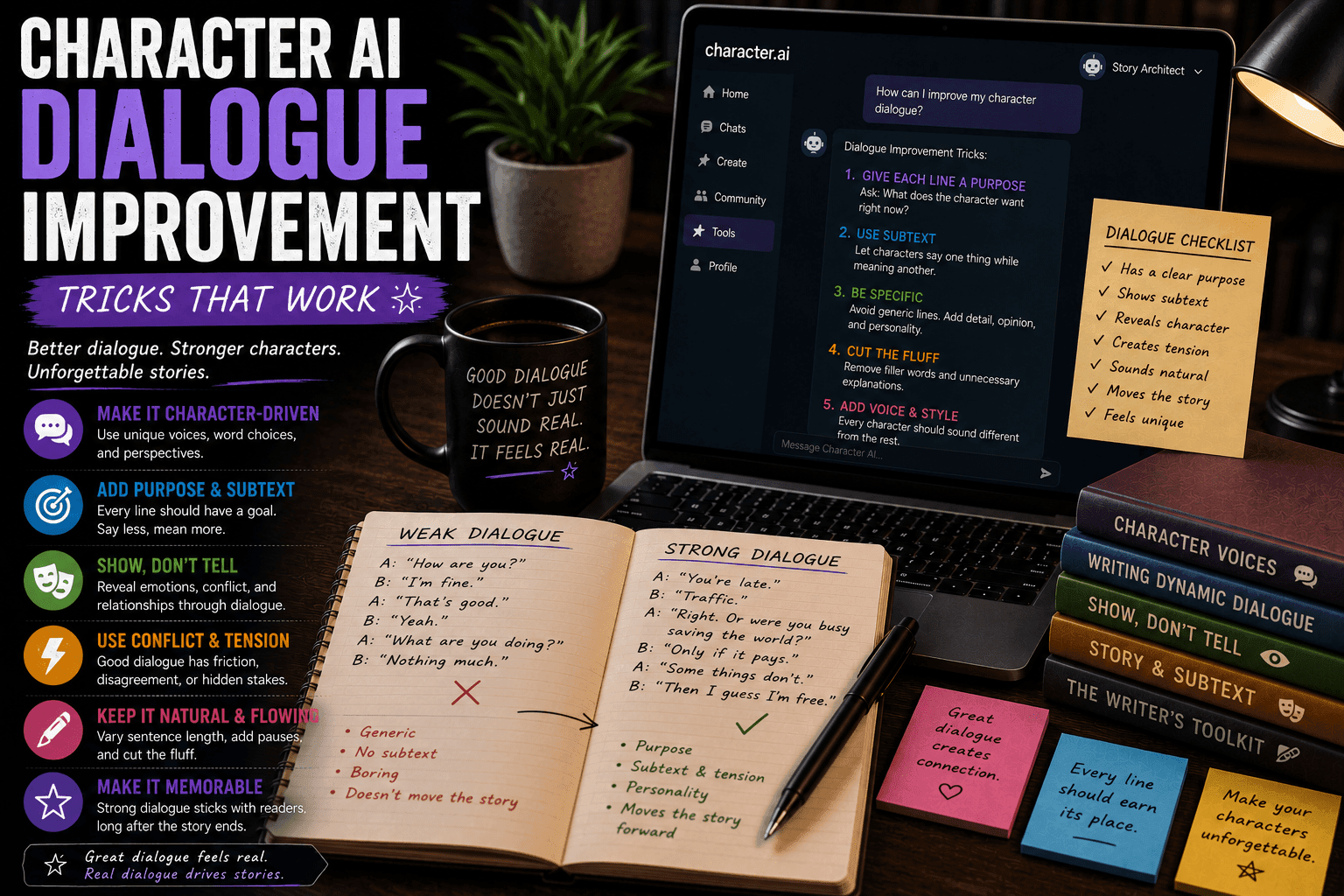
What Makes Dialogue Feel Good (And Bad)
Before fixing dialogue, understand the difference.
Weak Dialogue:
- Too formal
- No emotion
- No conflict
- Repetitive phrasing
- Direct, obvious responses
Strong Dialogue:
- Has tension
- Reveals character
- Uses subtext
- Feels natural, not perfect
- Moves the story forward
If your dialogue isn’t doing at least two of these things, it’s probably filler.
Why Character AI Dialogue Falls Flat
1. Safe Prompts
Generic prompts create generic responses.
2. No Personality Design
Characters sound identical without defined voices.
3. Lack of Conflict
Agreement kills engagement.
4. Over-Explanation
Characters say too much instead of implying meaning.
The solution isn’t complicated, just ignored.
Dialogue Improvement Tricks (That Actually Work)
Trick 1: Give Every Character a Clear Voice
If two characters speak the same way, your dialogue is already broken.
Define:
- Tone (sarcastic, calm, aggressive)
- Vocabulary level
- Sentence length
Example:
“You speak in short, blunt sentences and rarely explain yourself.”
Now the AI has boundaries.
Trick 2: Add Conflict to Every Exchange
Even small disagreement improves dialogue.
Instead Of:
“Yes, I agree.”
Try:
“Sure. If you ignore everything that went wrong last time.”
Conflict = engagement.
Trick 3: Use Subtext, Not Direct Statements
Real people don’t say exactly what they mean.
Instead Of:
“I don’t trust you.”
Try:
“You always show up when things go bad. Funny how that works.”
Same meaning. Better delivery.
Trick 4: Cut the First Response
AI often starts with a safe, boring reply.
Delete it.
The second or third version is usually sharper.
Trick 5: Shorten Dialogue Lines
Long responses kill pacing.
Aim For:
- 1–2 sentences per line
- Quick back-and-forth rhythm
Fast dialogue feels more natural.
Trick 6: Add Emotional Direction
Tell the AI how the character feels.
Example:
“You’re angry but trying to stay calm.”
Now the dialogue has tension beneath the words.
Trick 7: Interrupt the Flow
Perfect conversations don’t exist.
Add:
- Interruptions
- Topic shifts
- Avoidance
Example:
“That’s not— you know what, forget it.”
Instant realism.
Trick 8: Force Decisions in Dialogue
Make characters choose something.
Example:
“You have 10 seconds to decide.”
Now dialogue has urgency.
Trick 9: Use Reaction-Based Prompts
Instead of asking for dialogue, trigger reactions.
Example:
“How would your character respond if they were accused of betrayal?”
This produces more dynamic output.
Trick 10: Rewrite for Impact
AI gives you raw material. You refine it.
Improve:
- Word choice
- Timing
- Subtext
This is where good dialogue becomes great.
Example Before vs After
Weak Dialogue:
“I think we should leave because it is dangerous.”
Improved Dialogue:
“You still think this is a good idea?”
Shorter. Sharper. More tension.
Advanced Dialogue Techniques
1. Layered Emotion
Characters feel conflicting emotions at once.
2. Power Shifts
Change who controls the conversation.
3. Hidden Agendas
Characters want something they don’t say directly.
4. Dialogue Compression
Remove unnecessary words to tighten pacing.
Common Dialogue Mistakes
1. Over-Explaining
Kills subtext.
2. No Conflict
Makes scenes boring.
3. Identical Voices
Breaks immersion.
4. Long Monologues
Slows everything down.
Best Tools for Dialogue Improvement
- Character.AI
- Janitor AI
- Tavern AI
Each allows interactive dialogue testing and refinement.
Final Thoughts
Improving dialogue with Character AI isn’t about better technology. It’s about better technique.
If you apply these tricks, you’ll get:
- More natural conversations
- Stronger character voices
- Sharper, more engaging scenes
If you don’t, you’ll keep generating dialogue that sounds like it was approved by a committee.
FAQs
How do I improve AI dialogue quickly?
Add conflict, shorten lines, and use subtext.
Why does AI dialogue feel robotic?
Because prompts are too safe and generic.
Can beginners improve dialogue easily?
Yes, with structured techniques.
Should dialogue be perfect?
No, imperfection creates realism.
What’s the biggest improvement trick?
Adding conflict and emotional context.
Conclusion
Character AI can produce excellent dialogue if you guide it properly. With the right tricks, you can transform flat conversations into engaging, realistic exchanges that actually carry your story.
And if your dialogue is still boring after this, at least now you know exactly where things went wrong.