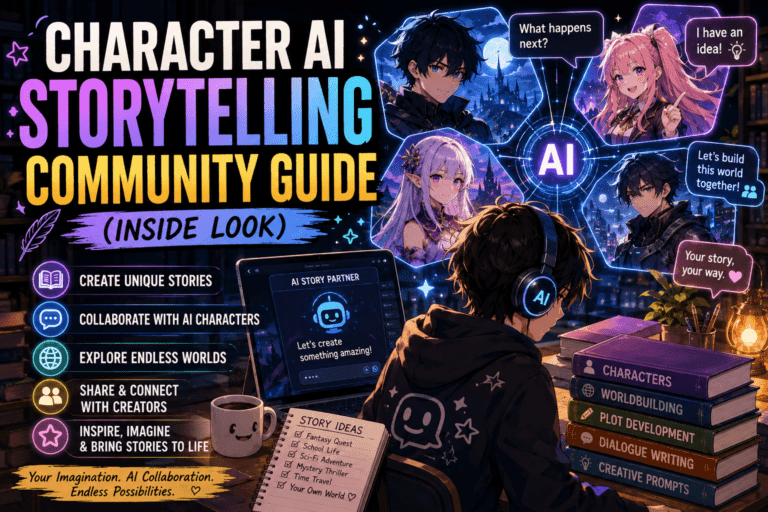

Dialogue trees have long been the backbone of narrative-driven games—from classic RPGs to modern interactive storytelling. But with the rise of AI platforms like Character.AI, developers and creators are rethinking how dialogue systems are built.
Instead of writing every branch manually, Character AI enables dynamic, responsive dialogue systems that feel less scripted and more alive. The result: conversations that adapt in real time while still maintaining structure.
This guide breaks down how to design Character AI dialogue trees for games—whether you’re building an indie project, prototyping narrative systems, or experimenting with AI-driven storytelling.
Character AI: What It Is, How It Works, and Why Millions Use It (Complete Guide)
Table of Contents
How to design branching conversations using Character AI for immersive, player-driven storytelling
What Is a Dialogue Tree (in the AI Context)?
Traditional dialogue trees are:
- Prewritten branches
- Fixed player choices
- Predictable outcomes
AI-driven dialogue trees, powered by models similar to those from OpenAI (e.g., GPT-4), introduce:
- Dynamic responses instead of fixed lines
- Context-aware branching
- Emergent dialogue paths
Instead of scripting every possibility, you design the rules and personality, then let the AI generate the conversation.
Traditional vs AI Dialogue Trees
| Feature | Traditional Dialogue | AI Dialogue (Character AI) |
|---|---|---|
| Structure | Fully scripted | Semi-structured |
| Variability | Limited | High |
| Writing effort | High upfront | Shifted to prompt design |
| Replayability | Moderate | Very high |
| Player agency | Predefined | Adaptive |
Core Components of a Character AI Dialogue Tree
To make AI dialogue usable in games, you still need structure. The key is blending control with flexibility.
1. Character Prompt (The Foundation)
Your prompt defines:
- Personality
- Goals
- Emotional tendencies
- Knowledge boundaries
Example:
“You are a cautious merchant who distrusts strangers but values profit. You speak carefully and avoid revealing too much.”
This acts as the “root node” of your dialogue tree.
2. Player Intent Mapping
Instead of fixed dialogue options like:
- “Buy item”
- “Ask about rumors”
You map intent categories:
- Trade
- Information
- Persuasion
- Threat
The AI interprets player input and responds accordingly.
3. State Variables (Critical for Games)
To maintain consistency, you simulate game state:
- Trust level
- Quest progress
- Relationship status
Example:
| Variable | Effect |
|---|---|
| Trust = Low | Defensive responses |
| Trust = High | Open, helpful dialogue |
| Quest Active | Provides hints |
These states can be injected into the prompt dynamically.
4. Branch Constraints
Even with AI, you need guardrails:
- “Do not reveal quest reward unless trust is high”
- “Avoid breaking character”
- “Keep responses concise and in-world”
Constraints prevent narrative drift.
Example Dialogue Tree (Hybrid AI Structure)
Instead of a rigid tree, think of it as a controlled flow system:
| Player Input | AI Interpretation | Response Type |
|---|---|---|
| “Show me what you’re selling” | Trade intent | Inventory dialogue |
| “Heard anything strange?” | Information | Rumor generation |
| “Tell me now or else” | Threat | Defensive or escalated response |
The AI fills in the dialogue—but within defined lanes.
Designing Dialogue Loops (The Game-Changer)
Unlike static trees, AI dialogue thrives on loops:
- Player interacts
- AI responds dynamically
- State updates
- New response context is generated
This creates:
- Evolving conversations
- Replayable interactions
- Emergent storytelling
Prompt Template for Game Dialogue Trees
Here’s a simplified reusable structure:
Character Definition
- Personality
- Background
- Speaking style
Rules
- Stay in character
- Respect game state variables
- Do not reveal restricted information
State Injection
- Trust level
- Active quests
- Player reputation
Response Guidelines
- Be concise
- Offer choices indirectly
- React emotionally when appropriate
Advanced Techniques
1. Soft Branching Instead of Hard Choices
Instead of forcing:
“Choose A, B, or C”
Let players type freely.
The AI maps their input to intent categories, making interactions feel natural.
2. Emotional Memory Simulation
Even without persistent memory, you can simulate it:
- “You remember the player insulted you earlier”
- “You are more cooperative after being helped”
This creates continuity.
3. Dialogue Weighting
Control likelihood of responses:
- High trust → helpful responses
- Low trust → evasive answers
This mimics probability-based branching.
4. Hybrid Systems (Best of Both Worlds)
Many developers combine:
- Prewritten key story beats
- AI-generated filler dialogue
This ensures narrative consistency while keeping interactions dynamic.
Common Pitfalls
Over-Reliance on AI
Without structure:
- Dialogue becomes inconsistent
- Story coherence breaks
Lack of Constraints
AI may:
- Reveal spoilers
- Break immersion
- Go off-topic
Ignoring Game State
Without state tracking:
- NPCs feel forgetful
- Player choices lose impact
When to Use Character AI Dialogue Trees
Best suited for:
- RPGs and narrative games
- Sandbox experiences
- Interactive fiction
- Prototyping dialogue systems
Less ideal for:
- Highly linear stories
- Competitive or fast-paced gameplay
The Bigger Shift: From Trees to Systems
The biggest change is conceptual:
You’re no longer writing dialogue trees—you’re designing dialogue systems.
Character AI transforms conversations from:
- Static content → Dynamic behavior
That shift opens the door to:
- Infinite variations
- Player-driven storytelling
- Scalable narrative design
Key Takeaways
- Character AI enables dynamic, semi-structured dialogue systems for games
- Prompts replace large portions of traditional scripted dialogue
- State variables are essential for maintaining consistency
- Hybrid systems (AI + scripted content) offer the best balance
- Dialogue design is shifting from trees to adaptive systems
FAQ
Can Character AI fully replace dialogue trees?
Not entirely. It works best when combined with structured systems and constraints.
Do I need coding skills to use this?
Basic integration may require development knowledge, but prompt design is accessible to non-developers.
How do you control AI responses in games?
Through prompts, constraints, and injected state variables.
Is this suitable for indie game developers?
Yes. It can significantly reduce writing workload while increasing replayability.
What are the risks of AI dialogue systems?
Inconsistency, lack of control, and potential immersion breaks if not designed carefully.
Can this work in real-time games?
Yes, but response speed and system design need optimization.