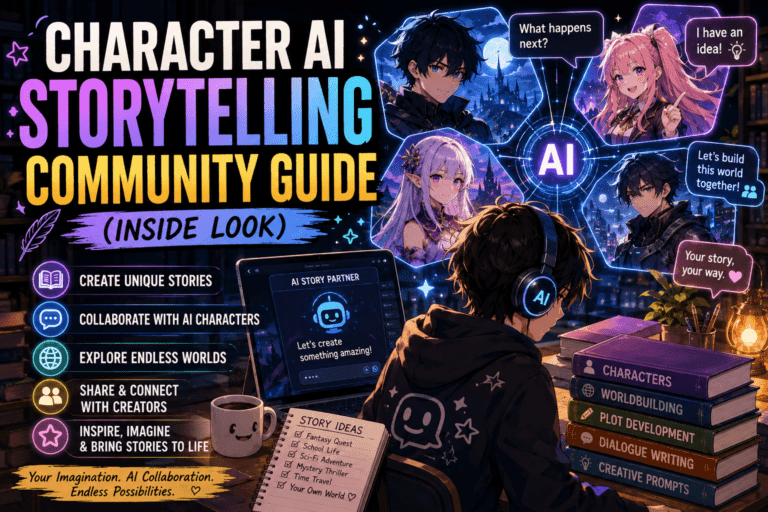

How modern AI-driven dialogue systems are reshaping branching narratives, NPC behavior, and player choice in game development
Dialogue systems sit at the heart of narrative-driven games. From classic branching trees to dynamic AI-generated conversations, the way characters communicate with players directly shapes immersion, replayability, and emotional impact.
With the rise of tools like Character.AI and large language models, developers are rethinking traditional dialogue trees. Instead of rigid, pre-scripted paths, games can now simulate fluid, context-aware conversations—blurring the line between authored storytelling and emergent gameplay.
Character AI: What It Is, How It Works, and Why Millions Use It (Complete Guide)
This guide explains how character AI dialogue trees work, how they differ from traditional systems, and how to design them effectively for modern games.
Table of Contents
How to write perfect dialogue trees for games
What Are Dialogue Trees in Games?
Dialogue trees are structured conversation systems where player choices lead to different responses, outcomes, or story branches.
Traditional Structure
At a basic level, dialogue trees consist of:
- Nodes: Individual lines of dialogue
- Branches: Player choices leading to different paths
- Conditions: Rules that determine availability
- Outcomes: Changes to story, relationships, or game state
Example Flow
| Node Type | Example |
|---|---|
| NPC Dialogue | “Do you trust me?” |
| Player Choice A | “Yes.” |
| Player Choice B | “No.” |
| Outcome A | NPC becomes ally |
| Outcome B | NPC becomes hostile |
This structure has powered RPGs for decades—from linear conversations to deeply branching narratives.
How Character AI Changes Dialogue Trees
Modern AI systems introduce dynamic generation, allowing dialogue to adapt in real time rather than relying entirely on pre-written scripts.
Key Differences
| Traditional Dialogue Trees | AI-Driven Dialogue Systems |
|---|---|
| Pre-written lines | Generated responses |
| Fixed branches | Adaptive conversation |
| Limited replayability | High variability |
| Author-controlled | Model-influenced behavior |
Platforms like OpenAI models and conversational engines inspired by Character.AI enable NPCs to:
- Remember context
- Adjust tone dynamically
- Respond to unexpected player input
- Simulate personality traits
Types of Dialogue Systems in Modern Games
1. Static Branching Trees
- Fully scripted
- Predictable outcomes
- Easier to test and control
Best for: Story-heavy RPGs, visual novels
2. Conditional Dialogue Systems
- Dialogue changes based on:
- Player stats
- Reputation
- Previous choices
Example Use Case:
An NPC reacts differently if the player has high charisma.
3. Hybrid AI Dialogue Trees
- Core structure is scripted
- AI fills in variations or expands responses
Common approach in modern design
4. Fully AI-Generated Dialogue
- Minimal scripting
- AI drives conversation flow
Risks:
- Narrative inconsistency
- Loss of authorial control
Core Components of AI Dialogue Trees
1. Intent Recognition
The system interprets what the player means, not just what they select.
- Keywords
- Semantic understanding
- Context tracking
2. Memory Systems
AI characters track:
- Past interactions
- Player behavior
- Emotional tone
This creates continuity across conversations.
3. Personality Modeling
Each NPC is defined by:
- Traits (e.g., aggressive, shy)
- Speech patterns
- Moral alignment
These guide AI-generated responses.
4. Dialogue Constraints
To maintain narrative consistency, developers often apply:
- Topic boundaries
- Lore restrictions
- Tone filters
Designing Effective AI Dialogue Trees
Start with Structure, Not Chaos
Even with AI, you still need a backbone.
Best practice:
- Define key narrative beats
- Anchor critical story moments
- Let AI handle variations—not core plot
Use Guardrails
AI systems need limits to avoid breaking immersion.
Examples:
- Prevent lore contradictions
- Restrict out-of-character responses
- Filter inappropriate outputs
Blend Choice and Freedom
Too much freedom can overwhelm players.
Balanced design:
- Offer clear choices
- Allow AI to expand within those choices
Test Extensively
AI dialogue introduces unpredictability.
Test for:
- Logical consistency
- Tone alignment
- Repetition issues
- Edge-case responses
Tools and Engines for Dialogue Systems
Game Engines
- Unity — Flexible scripting and plugin ecosystem
- Unreal Engine — Advanced visual scripting (Blueprints)
Dialogue Tools
- Ink by Inkle
- Yarn Spinner
AI Integration
- OpenAI APIs
- Custom LLM pipelines
- Middleware conversational systems
Example: Hybrid AI Dialogue Flow
| Step | System Action |
|---|---|
| 1 | Player selects intent (“Ask about mission”) |
| 2 | Game checks story state |
| 3 | AI generates contextual response |
| 4 | System validates output against rules |
| 5 | Dialogue presented to player |
This approach combines structure with flexibility.
Challenges of AI Dialogue Trees
Narrative Consistency
AI may generate responses that conflict with story canon.
Performance Costs
Real-time AI generation requires:
- Processing power
- Latency management
- Optimization strategies
Authorial Control
Writers may lose precision over:
- Tone
- Pacing
- Character arcs
Ethical and Content Risks
- Offensive or inappropriate outputs
- Bias in generated dialogue
Future of Dialogue Systems in Games
AI dialogue systems are moving toward:
- Persistent NPC memory across sessions
- Emotionally responsive characters
- Fully unscripted side interactions
- Voice-driven conversations
Studios are increasingly exploring systems where dialogue becomes a core gameplay mechanic, not just a narrative layer.
Key Takeaways
- Dialogue trees remain foundational but are evolving with AI
- Hybrid systems offer the best balance between control and flexibility
- AI enables dynamic, context-aware NPC interactions
- Strong constraints and testing are essential for quality
- Future games will likely feature more emergent, unscripted dialogue systems
FAQ
What is a dialogue tree in games?
A dialogue tree is a structured system where player choices lead to different conversation paths and outcomes.
How does AI improve dialogue systems?
AI allows NPCs to generate dynamic, context-aware responses instead of relying solely on pre-written lines.
Are AI dialogue systems better than traditional ones?
They offer more flexibility and realism, but traditional systems still provide stronger narrative control.
Can indie developers use AI dialogue systems?
Yes, many tools and APIs make it accessible, though implementation complexity varies.
What are the risks of AI-generated dialogue?
Inconsistency, inappropriate responses, and loss of narrative control are key challenges.
Which engines support AI dialogue integration?
Popular engines like Unity and Unreal Engine support AI integration through APIs and plugins.