
Introduction
If your story feels flat, predictable, or weirdly polite… congratulations, you’ve discovered the absence of conflict. Nothing exposes weak writing faster than characters who all agree with each other and move the plot forward like coworkers in a meeting.
Conflict is the engine of storytelling. And Character AI, when used properly, can generate, test, and escalate conflict faster than you can overthink it.
This guide explains how a Character AI conflict generator works, how to use it effectively, and how to turn generated tension into compelling story moments.
Character AI: What It Is, How It Works, and Why Millions Use It (Complete Guide)
What Is a Character Conflict Generator?
A Character AI conflict generator is a structured way of using AI personalities to create tension between characters.
Instead of manually inventing disagreements, you:
- Define characters
- Introduce opposing goals
- Trigger interaction
- Observe conflict emerge naturally
It’s less about “generate conflict” and more about designing conditions where conflict is inevitable.
Why Conflict Matters (More Than You Think)
1. Drives the Plot
No conflict = no story movement.
2. Reveals Character
People show who they are under pressure.
3. Creates Emotional Impact
Tension keeps readers invested.
4. Builds Stakes
Conflict raises consequences.
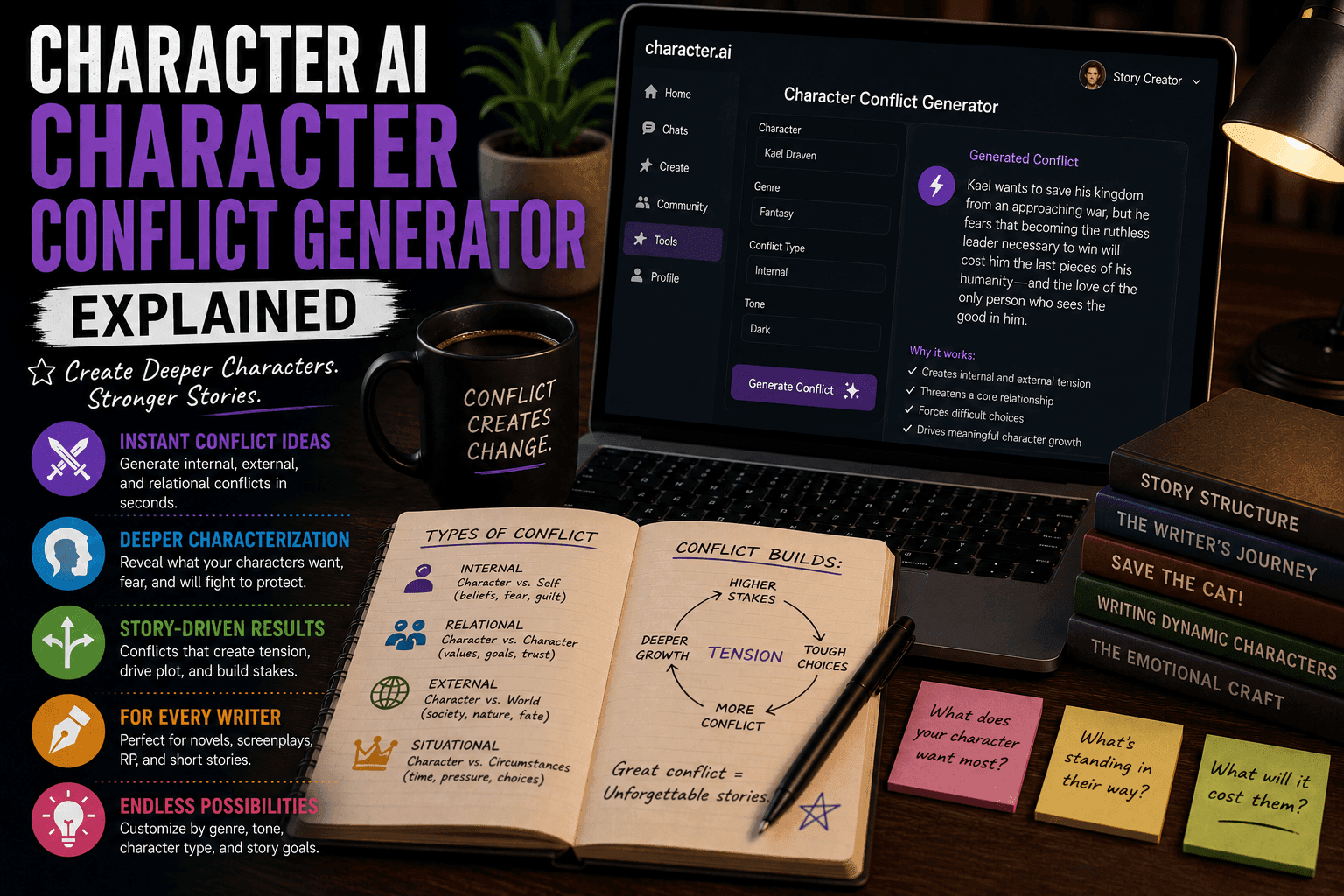
Types of Character Conflict You Can Generate
1. Internal Conflict
A character struggles with their own beliefs or emotions.
2. Interpersonal Conflict
Two characters want different things.
3. Ideological Conflict
Clashing values or worldviews.
4. Situational Conflict
External forces create pressure.
Character AI can simulate all of these if you prompt it correctly.
How Character AI Generates Conflict
At its core, conflict comes from incompatible goals.
Basic Formula:
- Character A wants X
- Character B wants Y
- X and Y cannot both happen
Now let them talk.
That’s it. That’s the magic people keep overcomplicating.
Step-by-Step Conflict Generation Workflow
Step 1: Define Two Opposing Characters
Create contrast.
Example:
Character A: Honest detective
Goal: Reveal the truth
Character B: Corrupt official
Goal: Hide the truth
Conflict is already built in.
Step 2: Assign Clear Goals and Stakes
Vague goals = weak conflict.
Add Stakes:
- What happens if they fail?
- What do they lose?
Now the tension matters.
Step 3: Create a Conflict Prompt
Guide the AI interaction.
Example Prompt:
“Simulate a tense conversation between a detective trying to expose the truth and an official trying to cover it up. Both characters are intelligent and refuse to back down.”
Now you get friction, not fluff.
Step 4: Start the Interaction
Let them clash.
Example:
Detective: “You’re hiding something.”
Official: “I’m protecting something.”
Already better than most dialogue online.
Step 5: Escalate the Conflict
Don’t let it stay mild.
Techniques:
- Increase stakes
- Introduce new information
- Add time pressure
Conflict should evolve, not repeat.
Step 6: Add Complications
Make things worse.
Examples:
- A secret is revealed
- A third character interrupts
- A decision must be made immediately
Now the scene has weight.
Step 7: Explore Multiple Outcomes
Test variations.
Try:
- One character wins
- Both lose
- Conflict escalates further
This improves story depth.
Step 8: Capture and Refine
Save the best parts.
Focus On:
- Strong dialogue
- Emotional beats
- Key turning points
Then rewrite for clarity and impact.
Advanced Conflict Techniques
1. Layered Conflict
Combine internal and external conflict.
2. Moral Dilemmas
Force characters to choose between bad options.
3. Power Shifts
Change who has control mid-scene.
4. Slow-Burn Conflict
Build tension gradually instead of immediate confrontation.
Common Mistakes to Avoid
1. Weak Opposition
If both characters want similar things, conflict dies.
2. No Stakes
Without consequences, tension feels fake.
3. Repetitive Arguments
Conflict should evolve, not loop.
4. Instant Resolution
Don’t solve conflict too quickly.
Example Conflict Scenario
Setup:
A scientist wants to release dangerous knowledge for progress.
A leader wants to suppress it for safety.
Result:
A high-stakes ideological conflict with no easy answer.
That’s the kind of tension readers remember.
Best Tools for Conflict Generation
- Character.AI
- Janitor AI
- Tavern AI
Each allows interactive character-based conflict simulation.
Final Thoughts
Character AI doesn’t create great conflict automatically. It gives you a fast way to test and refine it.
If you design strong opposing goals, you’ll get:
- Better dialogue
- Stronger scenes
- More engaging stories
If you don’t, you’ll get characters politely agreeing their way through your plot.
FAQs
What is a conflict generator?
A system for creating tension between characters.
Can AI generate realistic conflict?
Yes, with proper prompts and structure.
Is conflict necessary in every scene?
Almost always, in some form.
How do I improve conflict quality?
Increase stakes and opposition.
Can beginners use this?
Yes, it simplifies conflict creation.
Conclusion
Character AI makes conflict generation faster, more interactive, and easier to refine. With the right approach, you can consistently create tension that drives your story forward.
And if your characters still get along perfectly after this, you might be writing a friendship documentary instead of a story.