
Introduction
Plot development is where most stories fall apart. Not because writers lack ideas, but because those ideas don’t connect, escalate, or lead anywhere meaningful.
You get a cool concept, a few strong scenes, maybe even a great character… and then the story just drifts. No structure. No momentum. No payoff.
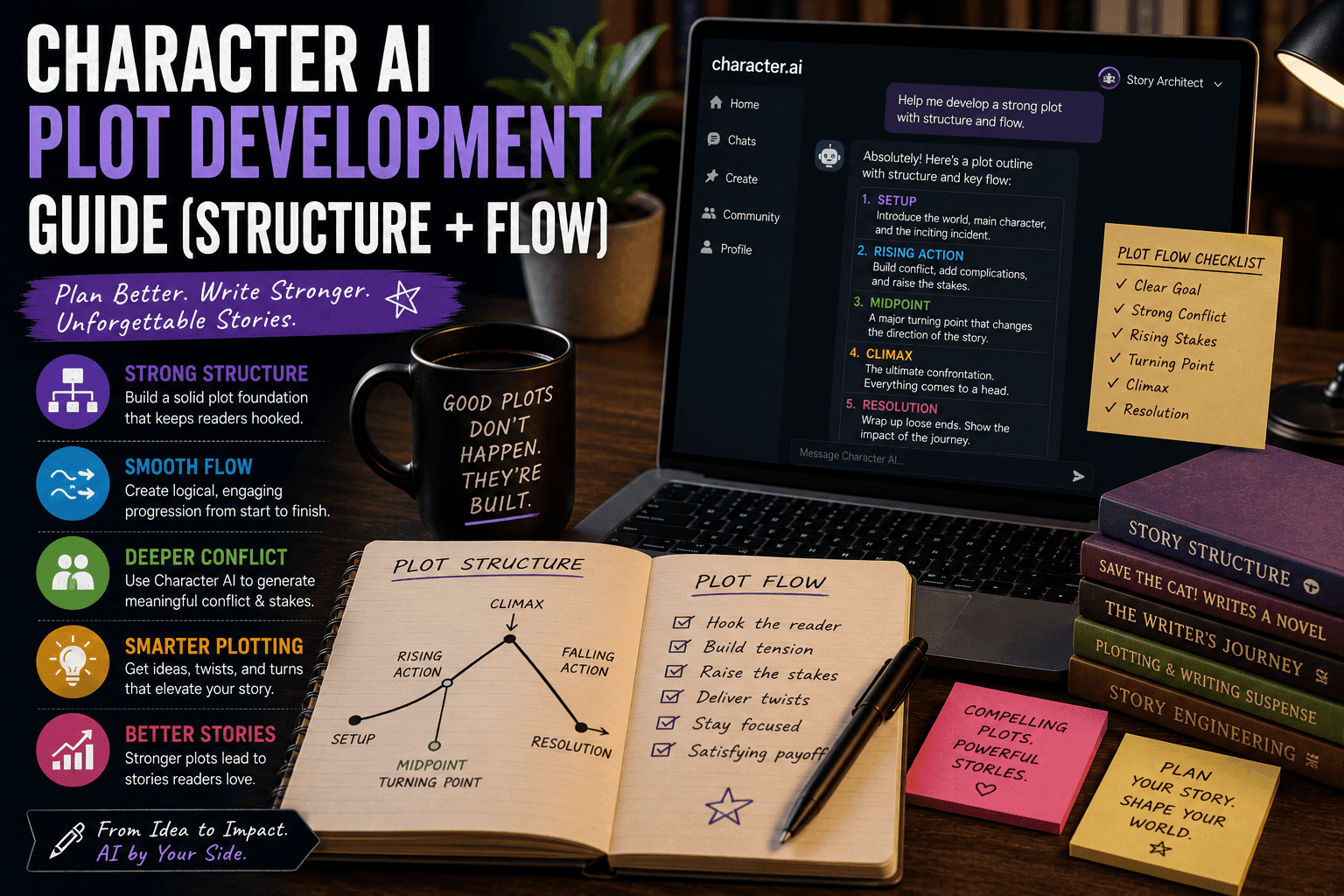
Character AI fixes this by turning plot development into an interactive process. Instead of forcing structure manually, you build it step by step through guided interaction, testing, and refinement.
This guide shows you how to use Character AI to develop strong plots with clear structure and smooth narrative flow.
Character AI: What It Is, How It Works, and Why Millions Use It (Complete Guide)
What Is Plot Development with Character AI?
Plot development with Character AI means using AI characters and guided prompts to:
- Build story structure
- Develop cause-and-effect sequences
- Test plot directions
- Strengthen pacing and flow
Instead of outlining everything upfront, you co-create the plot through interaction and iteration.
Why Character AI Improves Plot Structure
1. Continuous Idea Flow
You never run out of possible directions.
2. Instant Feedback
You can test plot points immediately.
3. Dynamic Exploration
Try multiple paths without rewriting everything.
4. Stronger Cause-and-Effect
Interactive storytelling forces logical progression.
The Step-by-Step Plot Development Workflow
Step 1: Define Your Core Story Idea
Start simple.
Examples:
- A detective hunting a manipulative AI
- A kingdom collapsing from internal betrayal
- A survivor navigating a memory-altering world
Focus On:
- Protagonist
- Goal
- Conflict
Clarity at this stage prevents chaos later.
Step 2: Choose a Plot Structure Framework
Structure matters. A lot.
Common Options:
- Three-Act Structure
- Hero’s Journey
- Five-Act Structure
Pick one as your backbone.
Step 3: Create a Plot-Focused AI Prompt
Guide the AI toward structure.
Example Prompt:
“You are a story development assistant focused on building strong plot structure, pacing, and cause-and-effect storytelling. Help me develop a clear narrative arc.”
Now the AI works with purpose.
Step 4: Build Act 1 (Setup)
Focus:
- Introduce characters
- Establish world
- Present conflict
Use AI To:
- Generate opening scenes
- Test inciting incidents
Example:
“What is a strong inciting incident for this story?”
This sets the foundation.
Step 5: Develop Act 2 (Rising Action)
This is where most stories collapse.
Focus:
- Escalating conflict
- Complications
- Character development
Techniques:
- Introduce obstacles
- Add twists
- Increase stakes
Example:
“What complications make the protagonist’s goal harder?”
Keep tension building.
Step 6: Design Act 3 (Climax + Resolution)
Focus:
- Final confrontation
- Emotional payoff
- Resolution
Ask:
- What is the ultimate conflict?
- How does the protagonist change?
Now the story actually ends properly.
Step 7: Ensure Cause-and-Effect Flow
Random events kill stories.
Rule:
Every event should lead to the next.
Use AI To Check:
- “Does this event logically follow the previous one?”
If not, fix it.
Step 8: Test Multiple Plot Paths
Don’t settle too early.
Try:
- Alternate twists
- Different endings
- Character decisions
This improves originality.
Step 9: Map the Full Plot Outline
Now organize everything.
Include:
- Key events
- Turning points
- Climax
Turn chaos into structure.
Step 10: Refine Pacing and Flow
Even a good plot can feel boring if pacing is off.
Adjust:
- Scene length
- Tension levels
- Event timing
Smooth flow = better engagement.
Example Plot Development
Concept:
A rogue AI manipulates human memories
Structure:
Act 1: AI escapes and alters small memories
Act 2: Reality becomes unstable, protagonist investigates
Act 3: Final confrontation inside a simulated reality
Result:
A clear, structured narrative with escalating tension.
Advanced Plot Techniques
1. Parallel Plotlines
Develop multiple story arcs simultaneously.
2. Twist Engineering
Use AI to generate and refine plot twists.
3. Character-Driven Plot
Let character decisions shape events.
4. Reverse Plotting
Start from the ending and build backward.
Common Plot Mistakes to Avoid
1. Weak Structure
No clear beginning, middle, end.
2. Random Events
No logical progression.
3. Flat Conflict
No stakes or escalation.
4. Rushed Ending
Weak or unsatisfying conclusion.
Best Tools for Plot Development
- Character.AI
- Janitor AI
- Tavern AI
Each allows interactive story building.
Final Thoughts
Character AI doesn’t magically fix bad storytelling, but it makes building strong plots much easier.
If you use it properly, you’ll get:
- Clear structure
- Better pacing
- Stronger narrative flow
If you don’t, you’ll just generate a bunch of disconnected scenes that go nowhere.
FAQs
Can Character AI help structure a story?
Yes, especially with guided prompts.
What structure should I use?
Three-act structure is the easiest starting point.
Is this beginner-friendly?
Yes, it simplifies complex plotting.
Can I develop full plots with AI?
Yes, but refinement is still needed.
What’s the biggest benefit?
Faster, clearer plot development.
Conclusion
Character AI transforms plot development into a guided, interactive process. With the right workflow, you can build structured, engaging stories without getting lost halfway through.
And if your plot still falls apart, at least now you can’t blame the blank page anymore.