
Introduction
Running out of story ideas is one of the most annoying problems in writing. You sit down, ready to create something brilliant, and your brain decides it’s time to go completely silent. Perfect timing, really.
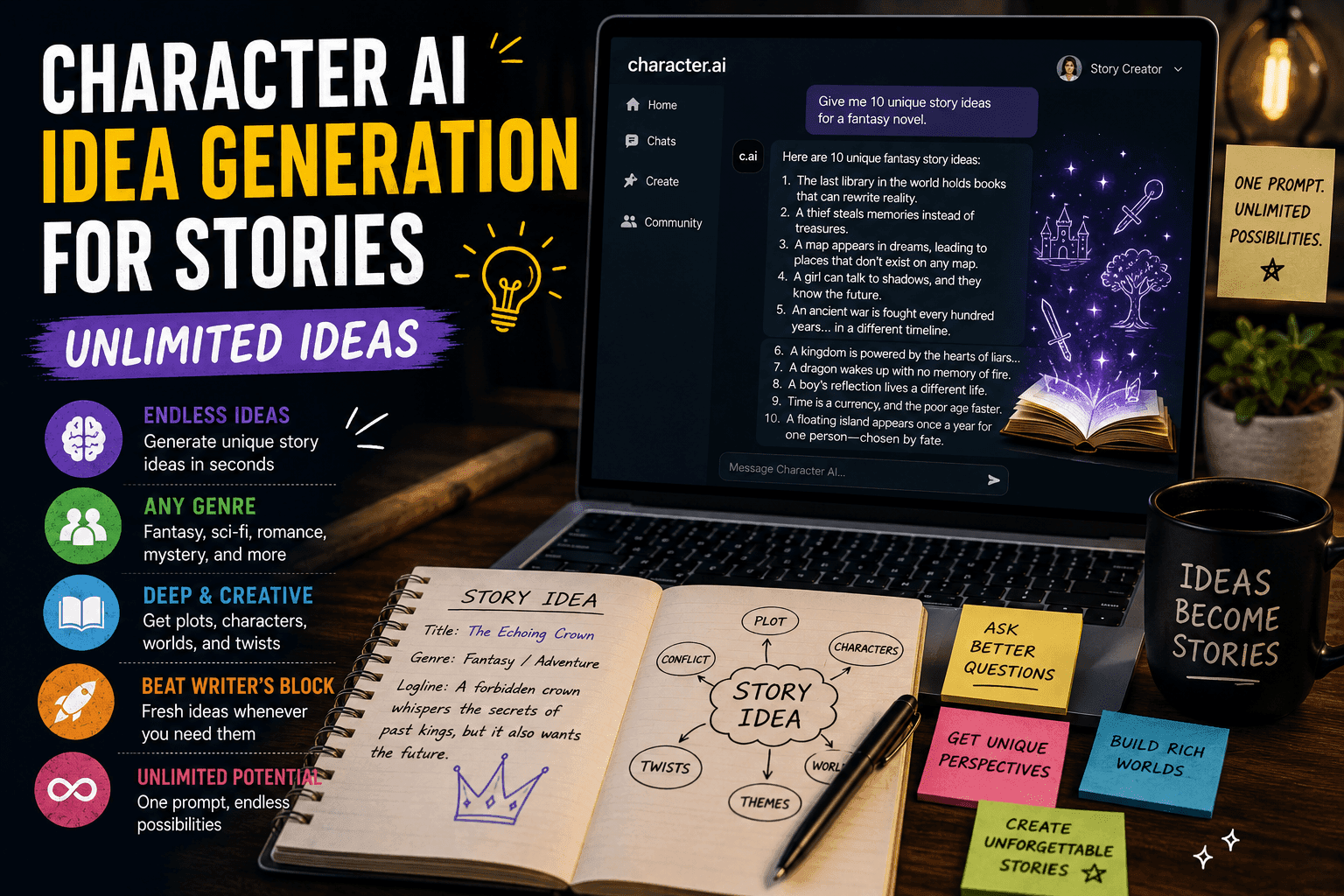
Now enter Character AI. Instead of forcing ideas out of thin air, you can generate them endlessly through interaction, exploration, and structured prompts.
This guide shows you exactly how to use Character AI to generate unlimited story ideas without producing generic, recycled nonsense.
Character AI: What It Is, How It Works, and Why Millions Use It (Complete Guide)
What Is Character AI Idea Generation?
Character AI idea generation is the process of using AI personalities to create story concepts through conversation and guided prompts.
Instead of relying on static lists, you:
- Interact with characters
- Explore scenarios
- Expand ideas dynamically
- Build concepts layer by layer
This turns idea generation into a continuous process rather than a one-time task.
Why Character AI Generates Better Ideas
1. Endless Output
AI doesn’t get tired or run out of ideas.
2. Multiple Perspectives
Different characters create different story angles.
3. Fast Iteration
You can generate, refine, and expand ideas instantly.
4. Creative Surprises
AI often combines ideas in unexpected ways.
Step-by-Step Idea Generation Workflow
Step 1: Define Your Idea Category
Start with a clear direction.
Examples:
- Fantasy story
- Sci-fi concept
- Romance plot
- Thriller twist
Weak Input:
“Give me ideas.”
Strong Input:
“I want a psychological thriller involving memory manipulation.”
Step 2: Select or Create an AI Character
Choose a character with a specific perspective.
Examples:
- Horror storyteller
- Sci-fi engineer
- Romantic poet
- Crime detective
Each one generates unique ideas.
Step 3: Use a Structured Idea Prompt
Example Prompt:
“You are a creative storyteller who generates unique and original story ideas. Focus on emotional depth and unexpected twists.”
This prevents bland results.
Step 4: Generate Initial Ideas
Start simple.
Example:
“Give me 5 unique story ideas based on memory manipulation.”
This creates your base pool.
Step 5: Expand Each Idea
Take one idea and push it further.
Ask:
- Who is the protagonist?
- What is the conflict?
- What is at stake?
Now the idea becomes usable.
Step 6: Use “What If” Technique
This is where ideas evolve.
Example:
“What if the memories being erased are actually fake?”
Now your story gains depth.
Step 7: Combine Multiple Ideas
Merge concepts to create originality.
Example:
- Idea 1: Memory manipulation
- Idea 2: Time travel
Combined:
A character discovers their memories are edited versions of alternate timelines.
Step 8: Generate Variations
Ask the AI to create multiple versions.
Example:
“Give me 3 darker versions of this idea.”
Variation increases quality.
Step 9: Filter the Best Ideas
Not every idea is good. Shocking, right.
Evaluate:
- Originality
- Emotional impact
- Expandability
Keep the strongest ones.
Step 10: Convert Ideas Into Story Concepts
Turn raw ideas into structured concepts.
Include:
- Characters
- Setting
- Conflict
- Theme
Now you have something worth writing.
Advanced Idea Generation Techniques
1. Multi-Character Brainstorming
Use multiple AI personalities for diverse ideas.
2. Constraint-Based Ideas
Limit themes or settings to boost creativity.
3. Genre Blending
Combine genres for originality.
4. Conflict Injection
Add tension to strengthen ideas.
Common Mistakes to Avoid
1. Generic Prompts
Leads to boring ideas.
2. No Direction
AI needs guidance.
3. Not Expanding Ideas
Surface-level concepts won’t work.
4. Over-Reliance on AI
You still need to refine and improve.
Example Idea Generation Session
Input:
“I want a sci-fi survival story.”
Output:
A crew stranded on a spaceship must delete parts of their memories to conserve system resources.
Expanded Concept:
They begin losing emotional connections, forcing them to choose between survival and identity.
Now that’s a story.
Best Tools for Character AI Idea Generation
- Character.AI
- Janitor AI
- Tavern AI
Each tool offers different levels of creativity and control.
Final Thoughts
Character AI gives you something writers have always wanted: unlimited ideas.
But unlimited doesn’t mean useful.
The real skill is:
- Asking better prompts
- Expanding ideas properly
- Refining outputs
Do that well, and you’ll never run out of stories again.
FAQs
Can Character AI generate unlimited ideas?
Yes, but quality depends on your prompts.
Are AI-generated ideas original?
They can be, if guided properly.
Is this good for beginners?
Yes, it simplifies idea generation.
How do I improve idea quality?
Use detailed prompts and refine outputs.
Should I rely fully on AI?
No, always edit and enhance ideas.
Conclusion
Character AI transforms idea generation into a fast, interactive process. With the right workflow, you can consistently produce unique story concepts without burning out.
And if you’re still stuck after all this, that’s not the AI’s fault anymore.